
The Best Boondocking Spots in Washington
I have spent a lot of nights parked on gravel in this state, and I will tell you straight: boondocking in Washington is some of the best free camping in the country if you understand one thing. There are two completely different kinds of public land here, and they play by different rules.
On the west side you have rainforest and rivers and national forest roads where dispersed camping is genuinely free. On the east side the sun comes out, the trees thin, and you start running into Washington Department of Natural Resources land where camping is allowed but you need a Discover Pass parked on your dash. Get that distinction wrong and you can come back to a ticket on a perfectly legal campsite. That one rule trips up more people than anything else out here.
The other thing nobody tells newcomers: the Cascades open late and close early. A lot of the good high country is snow gated well into June and back under snow by October. So this guide is built around what is actually reachable, organized by what kind of land you are sitting on, with real named roads I have either camped on or confirmed are still open.

Quick Answer
Yes, boondocking in Washington is legal and free on national forest land (Olympic, Gifford Pinchot, Mount Baker Snoqualmie, and Okanogan Wenatchee), where dispersed camping needs no pass and stay limits run 14 to 21 days. Some of the best free camping in Washington is on national forest roads like Forest Road 29 near Forks and the Mountain Loop Highway near Granite Falls. On Washington DNR state forest land, dispersed camping is also allowed in posted areas but you must display a Discover Pass to park.
The Rules You Actually Need to Know
National forest dispersed camping is free and needs no pass. This is the big one. On Olympic, Gifford Pinchot, Mount Baker Snoqualmie, and Okanogan Wenatchee national forests, you can pull onto a forest road and camp for free. No permit to camp.
DNR and state land needs a Discover Pass. Washington DNR manages huge working forests where dispersed camping is allowed in posted areas, but the Discover Pass is required to park. It runs $35 for an annual pass or $11.50 for a one day pass, and it has to be displayed in your windshield. This also covers State Parks and Fish and Wildlife lands.
The Discover Pass and the Northwest Forest Pass are not the same thing, and neither one is a camping permit. The Discover Pass is for state land. The Northwest Forest Pass ($5 per day or $30 per year) is a federal day use parking pass for certain national forest trailheads. Here is what people get wrong: you do NOT need a Northwest Forest Pass to dispersed camp on national forest land. It is for parking at day use trailheads, not for sleeping on a forest road. Free dispersed camping stays free.
Stay limits are typically 14 days, but check the specific forest. Most national forest and BLM land caps you at 14 days in a 28 day window. Olympic National Forest actually allows 21 consecutive days. Washington DNR campsites are usually 10 days in 30, and some, like the Teanaway, are even shorter.
Fire season closures and burn bans are real and they move fast. By mid to late summer the agencies start issuing campfire bans and sometimes full road closures, especially east of the crest. Olympic National Forest only allows campfires below 3,500 feet to begin with. Always check current conditions before you light anything, and have a backup plan because roads do close.
Camp on established sites, 100 to 200 feet from water, and pack everything out. Standard dispersed rules. Most national forests also limit how far you can pull off the road, usually within about 150 feet of the roadway and only on existing sites.
National Forests (the free stuff)
This is where you go when you want truly free camping in Washington with no pass on the dash.
Forest Road 29 near Forks (Olympic National Forest)
Out on the wet far side of the Olympic Peninsula, Forest Road 29 heads east out of Forks following the Calawah and Sitkum Rivers. It is one of the most RV friendly dispersed corridors in the state. The lower stretch is paved, then hard packed gravel, with dozens of pullouts.
Why it is special: it is deep rainforest, green and quiet, and a good basecamp for the Hoh and the coast. Decent Verizon and T Mobile signal too, which is rare out here.
Real sites: Forest Road 29 itself has several dozen pullouts; the first several miles are well packed and easy. Around mile 7 or 8 it gets rutted, so bigger rigs should grab a site before then.
Rig fit: Some pullouts handle 40 foot trailers, others only fit a van. Take the first big one you like rather than gambling deeper in.
Insider tip: This is rainforest. It rains here when it is sunny everywhere else in the state, and dirt pullouts turn to soup. Pick a gravel or hard packed site, not a grassy one, or you will be digging out.
Mountain Loop Highway near Granite Falls (Mount Baker Snoqualmie National Forest)
The Mountain Loop Highway out of Granite Falls is a classic. Once the pavement gives way to gravel, the river side pullouts start, a lot of them with existing fire rings.
Why it is special: easy reach from the Seattle side, real river access, and that mossy Cascade foothills feel without a long drive.
Real sites: The dispersed pullouts cluster along the gravel section of the Mountain Loop Highway; the better, more secluded ones are the riverside spots you reach by continuing past where the road turns to gravel.
Rig fit: Most are small pullouts. Great for vans and short trailers, tight for anything long. Scout on foot before you commit to backing in.
Insider tip: This is a popular weekend run from the city, so the good riverside spots fill by Friday afternoon in summer. Roll in Thursday or aim for a Sunday through Wednesday window.
North Fork Teanaway Road near Cle Elum (Okanogan Wenatchee National Forest)
Here is a spot that confuses everybody, so read carefully. The Teanaway Community Forest is DNR land and does NOT allow dispersed camping (more on that below). But keep driving up the North Fork Teanaway Road into the Okanogan Wenatchee National Forest and dispersed camping opens up along the river.
Why it is special: it is the sunny side of the Cascades, ponderosa and open river bars, an easy haul from Seattle but with east side weather.
Real sites: Dispersed sites line the national forest stretch of North Fork Teanaway Road, including riverside spots near the Teanaway Guard Station. First come first served, primitive, no facilities.
Rig fit: Mixed. River bar sites can take a midsize trailer; some side spurs are tight. The road is generally manageable for a capable tow rig.
Insider tip: Know exactly where the DNR Teanaway Community Forest boundary ends and the national forest begins. Below the line you are in designated campground only territory; above it you can disperse. The forest boundary is your green light.
McBride Lake area near Trout Lake and Mount Adams (Gifford Pinchot National Forest)
Down in the south Cascades around Trout Lake, the road network up toward Mount Adams has dispersed options with the big volcano right in your windshield.
Why it is special: Mount Adams views, huckleberry country in late summer, and far fewer crowds than the Mount Rainier side.
Real sites: McBride Lake on Forest Road 81 is a known small trailer friendly dispersed area near the mountain. From Trout Lake the route runs up toward Forest Road 23 and the surrounding network.
Rig fit: McBride Lake suits small trailers and vans. Some of the higher spur roads get narrow and rough, so do not push a long rig up unknown spurs.
Insider tip: This is high south Cascades. The good stuff melts out late, often not until well into June, and huckleberry season (and the bears that come with it) peaks in August and September. Plan around both.
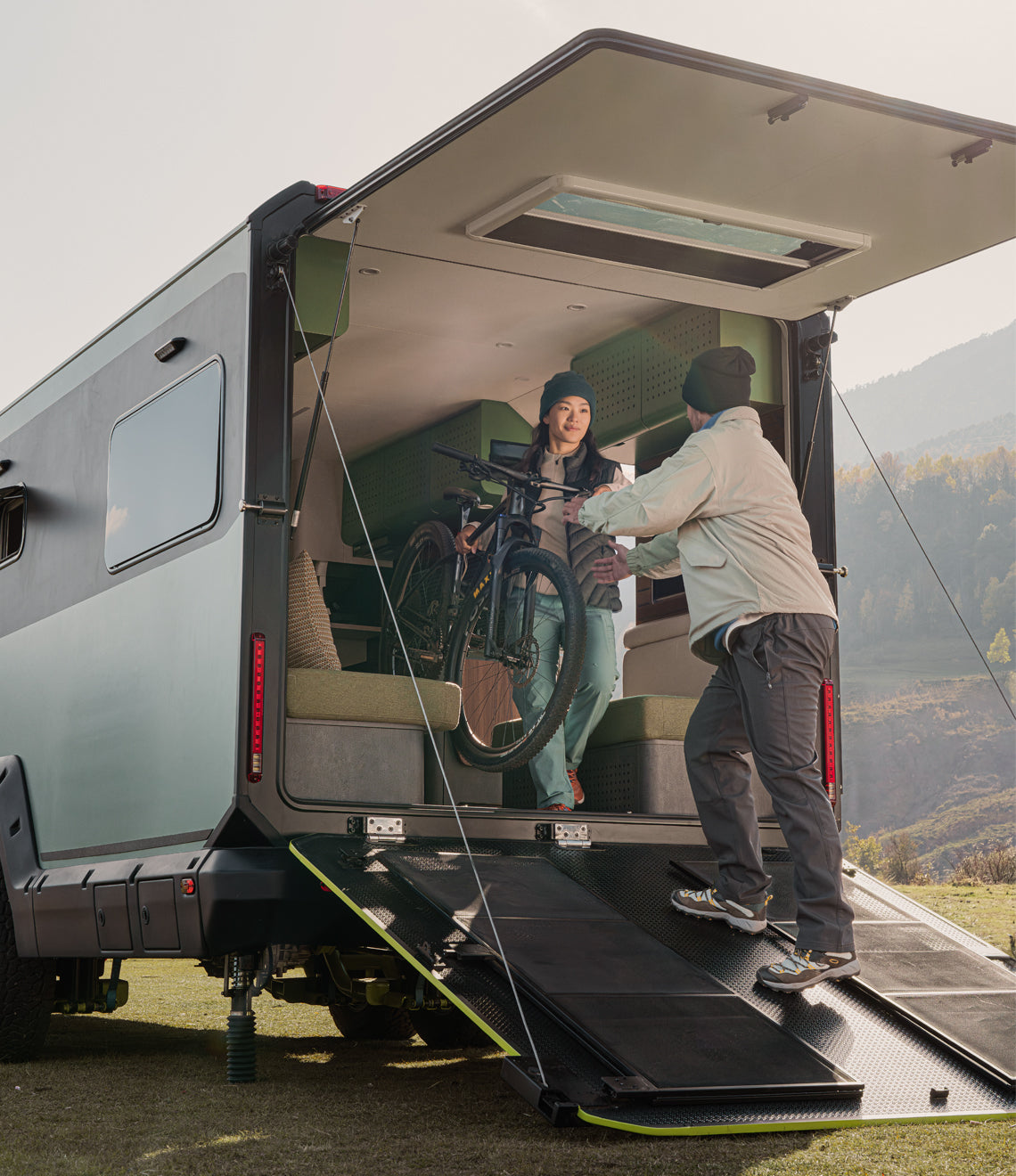
If you want a genuinely remote night out here, far from any hookup under classic gray Cascade sky, this is exactly the kind of place onboard power earns its keep. Solar barely sips a charge under that cloud cover, which is why a self contained rig like the Evotrex-PG5 travel trailer, with its massive LFP battery pack, integrated solar, and onboard gasoline generator, makes a spot like this livable for days instead of one cautious overnight.
DNR State Forest Land (free camping, but bring the Discover Pass)
This is the Washington specific category most out of state guides botch. DNR lands are working state forests, and in posted areas you can dispersed camp for free, as long as that Discover Pass is on the dash.
Ahtanum State Forest near Yakima (Washington DNR)
The Ahtanum State Forest is a 75,000 plus acre working forest in Yakima County, on the dry east side, managed by Washington DNR.
Why it is special: real east side sun, open ponderosa, and a network of Green Dot roads (DNR shorthand for roads open to motorized travel). It is a different world from the wet west side.
Real sites: Dispersed camping is allowed in the BBQ Flats area, with sites kept at least 100 feet from streams. First come first served at no extra cost beyond your Discover Pass.
Rig fit: BBQ Flats and the surrounding Green Dot roads can handle midsize rigs, but this is also OHV country, so expect company and rougher spurs.
Insider tip: On DNR land, dispersed campfires are often restricted or flat out prohibited, especially in dry season on the east side. Assume no fire unless a posting says otherwise, and never assume the rules match the national forest down the road.
Cascade Park in the Wenas area near Selah (Washington land, Discover Pass)
Tucked along Wenas Creek between Ellensburg and Selah, the Wenas area has a large dispersed camping zone known as Cascade Park (also called Wenas Camp), spread across a Green Dot road system.
Why it is special: it is a famous birding spot, open parkland, easy cross country walking, and a long standing free dispersed area on the dry side.
Real sites: Cascade Park is a large, unmarked dispersed area next to Wenas Creek with a few vault toilets spread across it. Free, first come first served, Discover Pass required.
Rig fit: Lots of open room for a range of rigs, but no marked sites, so pick a durable surface and spread out.
Insider tip: No potable water and the creek is not safe to drink, so haul in everything you need. Stay at least 50 feet off the creek, and expect a crowd around Memorial Day weekend when the annual Audubon campout takes over.
BLM Land (yes, it exists in Washington)
People say there is no BLM land in Washington. There is, mostly on the dry east side, and one piece is genuinely good.
Fishtrap Recreation Area near Sprague (Bureau of Land Management)
About 30 miles southwest of Spokane off Interstate 90 (Exit 254), Fishtrap is 9,000 acres of channeled scablands, lakes, and shrub steppe managed by BLM.
Why it is special: it is open year round, it is free with no pass at all, and it is a rare easy BLM boondock in this state. Quiet, big skies, good hiking on the Fishtrap Loop trails.
Real sites: Dispersed camping is allowed; the South Loop Trailhead lot has decent room for vehicles and RVs, with more limited space at the Folsom Farm and Hog Lake Loop trailhead lots. Several lots even have vault toilets.
Rig fit: The South Loop lot is your best bet for anything larger; the others are tighter.
Insider tip: This is shrub steppe, so it bakes in summer and there is almost no shade. Spring and fall are the sweet spots, and being year round, it is a solid shoulder season fallback when the Cascades are still snowed in.
At a Glance
|
Area |
Land type |
Pass needed |
Nearest town |
|
Forest Road 29 |
Olympic National Forest |
None |
Forks |
|
Mountain Loop Highway |
Mount Baker Snoqualmie NF |
None |
Granite Falls |
|
North Fork Teanaway Road |
Okanogan Wenatchee NF |
None |
Cle Elum |
|
McBride Lake / FR 81 |
Gifford Pinchot NF |
None |
Trout Lake |
|
Ahtanum State Forest (BBQ Flats) |
Washington DNR |
Discover Pass |
Yakima |
|
Cascade Park / Wenas |
Washington land |
Discover Pass |
Selah |
|
Fishtrap Recreation Area |
BLM |
None |
Sprague |
Paid Fallbacks Worth Knowing
When the dispersed spots are full, snowed out, or burned closed, these keep you off the highway.
-
National forest campgrounds like Big Creek near Lake Cushman: cheap, established, and open when the high country is not.
-
Washington State Parks: plentiful, reservable, and your Discover Pass already covers day use parking.
-
DNR designated campgrounds like the Teanaway Camping Area: free beyond your Discover Pass, first come first served, with actual fire rings.
Don't Take My Word for It, Check Before You Roll
Conditions, road closures, and fire bans change constantly out here. Before any trip, pull up the actual land manager:
A few more habits that save trips: pull the Motor Vehicle Use Map (MVUM) for whichever national forest you are headed to so you know which roads legally allow camping; download the Avenza Maps app and load that MVUM so it works with no signal; and when in doubt, call the local Ranger District or DNR region office and just ask. They will tell you what is open and what is closed faster than any blog.
FAQ
Is boondocking legal in Washington?
Yes. Dispersed camping is legal and free on national forest land, allowed on posted DNR state forest land with a Discover Pass, and allowed on most BLM land. It is generally not allowed in cities or on the street, where local overnight parking ordinances apply.
Is there BLM land in Washington?
Yes, though far less than in western states. Most of it is on the dry east side. Fishtrap Recreation Area near Sprague is the standout, with free year round dispersed camping and no pass required.
Where can you boondock free in Washington?
The truly free, no pass options are national forest roads (Forest Road 29 near Forks, the Mountain Loop Highway near Granite Falls, North Fork Teanaway Road near Cle Elum) and BLM land like Fishtrap. DNR land such as Ahtanum State Forest is free to camp but requires a Discover Pass to park.
Do you need a Discover Pass for boondocking?
Only on Washington state managed land (DNR, State Parks, Fish and Wildlife). You do NOT need one for national forest or BLM dispersed camping. And the Discover Pass is not the same as the federal Northwest Forest Pass, which is a day use trailhead parking pass, not a camping permit.
When is the best time for boondocking in Washington?
The reliable window is roughly July through September, when the Cascade high country is snow free and east side weather is sunny. Spring and fall are great on the dry east side and at low elevation BLM land like Fishtrap, but watch for fire bans late in summer.
Things to Watch Out For
A few practical things every boondocker should sort out, plus the hazards that are specific to this state.
You will have no water and no dump out there, so arrive with full fresh tanks and empty grey and black, and plan your dump and refill around towns. For finding and vetting sites, lean on Campendium, iOverlander, and The Dyrt; read the recent reviews, since road washouts and closures show up there before they hit official pages.
Now the Washington specific stuff:
-
Rain and mud on the west side: the Olympic and west Cascade roads get genuinely wet, and dirt pullouts turn to mud traps. Pick gravel sites and respect your traction.
-
Snow gated roads and a short high season: much of the Cascades is locked under snow into June and back under it by October. Confirm a road is melted out before you commit to a long drive.
-
Fire season closures and burn bans: by late summer, campfire bans and full road closures are common, especially east of the crest. Check current conditions and always have a backup.
-
Discover Pass enforcement: on DNR, State Parks, and Fish and Wildlife land, rangers do check windshields. A legal campsite with no pass on the dash is still a ticket.
-
Bears: both sides of the state have black bears, and huckleberry season in the south Cascades draws them in. Store food properly and keep a clean camp.