
RV with patio, a guide to deck types, pros, and trade-offs
An RV with a patio takes the best part of camping, the hours you spend outside, and gives them a real floor. Instead of folding chairs balanced on gravel, you get a flat, clean platform attached to your rig where meals, coffee, and conversation actually happen. Patios used to be a rare feature reserved for a few specialty rigs, but they now show up across toy haulers, destination trailers, and a new generation of travel trailers, including the Evotrex-PG5 with its Terrece™ roofed rear patio. This guide covers what an RV patio is, the main types, what they add to camp life, and what to think through before you buy one.

What counts as an RV patio
An RV patio is a built-in deck or platform that extends your rig's living space outdoors. It is part of the trailer itself, which separates it from an awning over bare ground or a mat you roll out at each site. When people search for a travel trailer with a patio, they usually mean a platform that folds, deploys, or attaches directly to the rig and gives you a finished outdoor floor at every campsite.
The idea borrows from home design. A travel trailer interior, however well laid out, has a finite footprint. A patio adds usable square footage the moment you park, and it does it without adding interior bulk you have to tow around all day.
The main types of RV patios and decks
Most patios on the market fall into four groups.
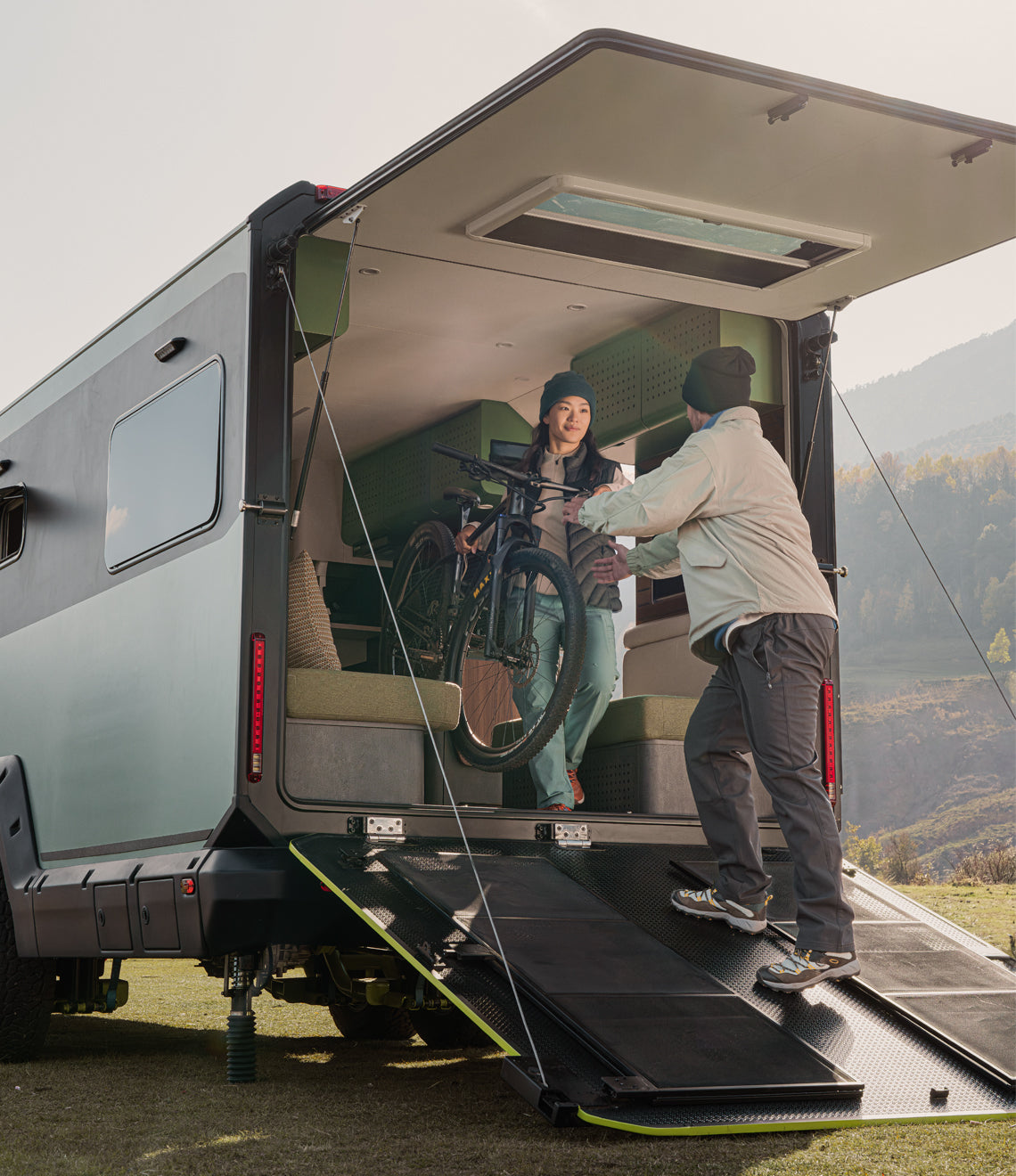
Ramp-door patios. Toy haulers popularized this design. The rear cargo ramp folds down flat, and with a railing kit and support cables it becomes a sturdy rear deck. It doubles as the loading ramp for bikes and gear, which is why the style has spread beyond toy haulers.
Factory side or rear decks. Some larger units and park-model style rigs build a dedicated deck into the floor plan, often with a sliding glass door opening onto it. Destination trailers lean this direction, since they sit at one site all season and treat the porch as a room.
Roofed motorized patios. The newest category. The platform deploys from the trailer at the press of a button and carries its own roof, so the outdoor space stays usable in weather that would end a session on an open deck.
Portable and seasonal setups. Freestanding decks, interlocking tiles, and heavy outdoor mats give any rig a patio-like floor. They take real setup time, but they work with the RV you already own.
How the patio types compare
| Patio type | How it deploys | Weather protection | Best for |
|---|---|---|---|
| Ramp-door patio | Fold down the rear ramp, add rails | None without an add-on canopy | Gear haulers who want dual use |
| Factory side or rear deck | Built in, minimal setup | Awning coverage at best | Long seasonal stays |
| Roofed motorized patio | Push-button deployment in seconds | Built-in roof over the platform | Frequent travelers who set up daily |
| Portable deck or mat | Manual assembly at each site | None | Adding outdoor floor to any rig |
Why campers love a camper with a patio
The appeal is bigger than it looks on a spec sheet. A patio adds genuine living space without adding interior length, and outdoor square footage is the cheapest square footage an RV can offer. Meals move outside. Muddy boots and sandy gear stop at the platform instead of tracking through the cabin.
A deck also fixes the terrain problem. Campsites are rarely flat, clean, or dry, and a patio gives you one surface that is always all three. Pets get a defined space. Kids get a stage. On designs where the platform doubles as a loading ramp, the same structure earns its keep twice, hauling gear on travel days and hosting dinner once you arrive.
What to think through before you buy
A few practical points separate a patio you use daily from one you stop deploying.
Weather exposure matters most. An open deck is wonderful in sunshine and useless in rain, so a roof, awning, or canopy determines how many hours the space actually earns. Railings matter if you camp with children or pets, especially on ramp-style decks that sit above the ground.
Setup effort decides real-world use. A patio that takes twenty minutes of rails and cables gets skipped on one-night stops, while a motorized platform gets used everywhere. Check your campsite habits honestly.
Finally, remember that a deck, its rails, and its hardware ride with the trailer, so factor them into your rig's ratings like any other equipment. A level trailer also matters more with a patio, since a tilted platform makes furniture wander and doors swing.
The Terrece™ roofed patio
The Evotrex-PG5 treats the patio as core living space. Its Terrece™ is an industry-first roofed patio that deploys in seconds at the press of a button, adds 43 sq ft of living space, and uses a two-layer roofed construction that keeps the outdoor room weather protected and the interior wall clean. Lowered further, the same platform works as a loading ramp for bikes, kayaks, and larger gear. Alongside it, a power awning extends 120 sq ft of shaded coverage without stakes or poles.
The short version
An RV with a patio adds real outdoor living space to your campsite, whether that is a toy hauler ramp deck, a built-in porch on a destination trailer, a roofed motorized platform, or a portable setup you assemble on site. Roof coverage and setup effort are the two factors that decide how often a patio actually gets used, so weigh those harder than looks. If you want the pushbutton version with weather protection built in, the PG5 pairs its Terrece™ patio with the onboard battery, solar, and power system that keep the rest of camp running.
Frequently asked questions
What is an RV patio?
An RV patio is a deck or platform built into the rig that extends living space outdoors. It differs from an awning or ground mat because it is a structural part of the trailer that gives you a finished floor at every site.
Do travel trailers come with patios?
Some do. Toy haulers offer ramp-door patios, destination trailers often include built-in porches, and newer designs offer motorized roofed patios. Portable deck kits can add similar function to trailers that ship without one.
Are RV decks safe for kids and pets?
They can be, with the right hardware. Look for solid railings, rated support cables or struts, and a platform that locks firmly in place. Supervise on ramp-style decks that sit well above the ground.
Can you add a patio to an existing RV?
Aftermarket railing kits can convert many toy hauler ramps into patios, and freestanding decks or tile systems work with almost any rig at a seasonal site. Structural additions beyond that are a job for a qualified shop.
What makes a roofed patio different from an awning?
An awning shades the ground beside the rig, while a roofed patio covers an actual platform attached to it. The roof keeps the deck usable in wet weather and keeps the adjacent interior wall clean.
By the Evotrex Travel Team. RV travelers and off-grid testers. Specs, prices, and rules change over time, so check official sources before you rely on them.