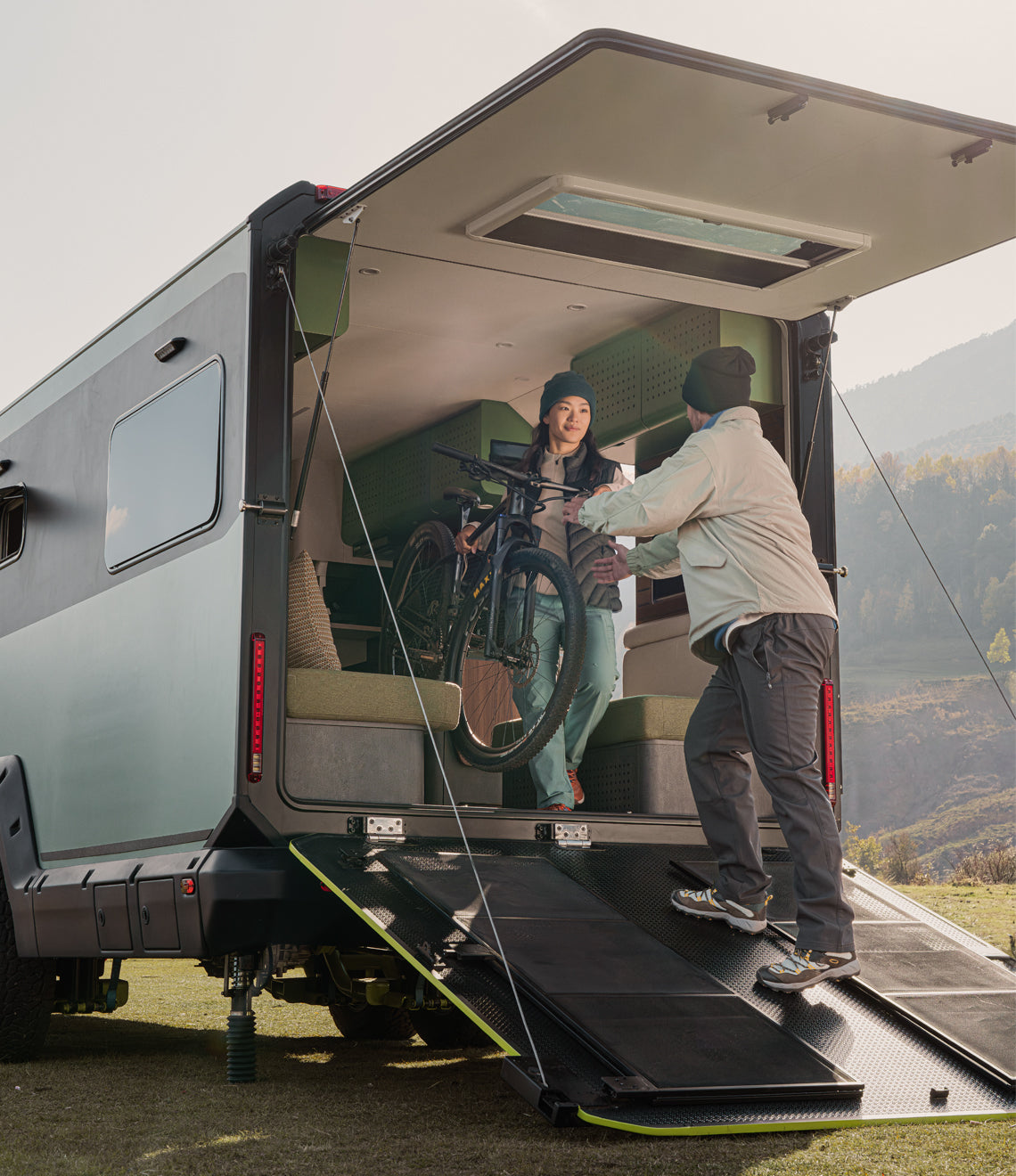

Off road RV guide, from suspension to self-sufficiency
Plenty of rigs wear knobby-tire graphics and rugged names, but a true off-road RV is defined by engineering rather than styling. The difference shows up the first time washboard gravel shakes a cabinet loose or a rutted forest road drags a low-hanging tank. This guide covers what actually separates an off-road RV from a pavement rig, so you can read past the decals and judge the hardware.

What off-road capable actually means
For most travelers, off-road use means maintained gravel, forest service roads, and unpaved approaches to remote campsites. Very few RVs are meant for rock crawling, and none need to be. The realistic goal is a rig that handles rough, loose, and uneven surfaces without damage, then supports you comfortably once you arrive somewhere with no services.
That breaks the question into two halves. Getting there depends on suspension, tires, clearance, and structure. Staying there depends on power, water, and heat, which is the half many buyers forget. A trailer that survives the road but dies after one night off-grid has only solved half the problem. Builders like Evotrex now design for both halves at once, which is reshaping what the category can do.
| Feature area | Typical pavement RV | Off-road-ready RV |
|---|---|---|
| Suspension | Basic leaf springs | Air or heavy-duty independent systems |
| Tires | Highway trailer tires | All-terrain tires with taller sidewalls |
| Clearance | Low tanks and plumbing | Raised, protected underbody |
| Structure | Wood-framed walls | Reinforced chassis, composite construction |
| Power | Hookup dependent | Large battery, solar, onboard generation |
Suspension and ground clearance
Suspension does two jobs off pavement. It keeps the tires in contact with an uneven surface, and it protects the living space from the constant hammering that destroys cheaply built interiors. Basic leaf-spring setups transfer every impact into the frame, which is why cabinets and fasteners work loose on rigs never meant for gravel.
Air suspension and other heavy-duty designs absorb that punishment instead, and they often allow ride-height adjustment for rough sections. Clearance matters just as much. Look under any rig you are considering and find the lowest hanging component, because that is what the trail will find first. Tanks, valves, and plumbing should sit protected above the frame line, never dangling beneath it.
Tires built for the surface
Standard trailer tires are built for smooth pavement, and their stiff, shallow tread struggles on loose surfaces. All-terrain tires change the equation with deeper tread for grip, tougher sidewalls against sharp rock, and larger diameters that roll over obstacles instead of dropping into them. A taller tire also adds clearance under the axles, exactly where you need it.
An all-terrain RV setup should include a matching full-size spare and a way to check pressures on the move, since airing down slightly is a common technique for washboard comfort. Whatever the tire, weight discipline still applies, so load thoughtfully and check your figures against your tow vehicle's ratings before pointing the rig at a mountain road.
Construction and chassis strength
Rough roads apply twisting forces that pavement never does, and the chassis carries all of it. Frames adapted from lightweight utility designs can flex enough to crack walls and pop seals over time. Purpose-built off-road rigs use stronger steel and engineering that anticipates the twist.
The body matters too. Wood-framed walls can loosen and rot after years of vibration and moisture, which is why serious builds have moved toward composite shells and metal framing. When you evaluate an off-road RV, ask the manufacturer directly how the chassis was engineered and what testing the structure has seen on rough surfaces. Vague answers are their own answer.
Self-sufficiency beyond the pavement
Reaching a remote site is the first half. Living well there is the second, because the places worth a rough drive rarely offer water, power, or dump stations. A capable off-road RV carries generous fresh water, protected waste tanks, and above all a power system sized for real daily use. Solar helps enormously in open country.
This is where the Evotrex-PG5 is a natural fit, because it pairs rough-road hardware with serious energy. The PG5 rides on air suspension and 33" all-terrain tires over a high-strength automotive-grade steel chassis, and it generates its own power through a 43 kWh LFP battery, 1.5 kW rooftop solar, and a quiet gasoline generator working as one system delivering 270+ kWh of usable energy per cycle. That combination supports 7+ days off-grid with daily HVAC and appliance use, which is exactly what remote country asks of a rig.
Know the rules before you leave the road
Off-road capability comes with responsibility, because most of the land you will explore is public. Much of the American West is managed by the Bureau of Land Management, and BLM land generally allows dispersed camping along established routes, with stay limits that vary by field office. The National Park Service is more restrictive, and vehicles must stay on designated roads in nearly all park units.
Check recreation.gov for site rules and seasonal closures before you commit to a route. Drive only on existing roads and tracks, camp on durable surfaces that have clearly been used before, and pack out everything you bring in. The rigs are more capable than ever, so the land depends on travelers using that capability carefully.
The short version
A real off-road RV earns the name in four areas, suspension that absorbs punishment, all-terrain tires with clearance to match, a chassis engineered for twisting forces, and the self-sufficiency to live comfortably once you arrive. Styling stripes cover none of those. If you want a single benchmark for the category, the Evotrex-PG5 combines air suspension, 33" all-terrain tires, and an automotive-grade steel chassis with a 43 kWh LFP battery and 1.5 kW rooftop solar that keep generating power long after the pavement ends.
Frequently asked questions
What is an off-road RV?
It is an RV engineered for unpaved and uneven surfaces, with upgraded suspension, all-terrain tires, extra ground clearance, and reinforced construction. Most are designed for gravel, forest roads, and remote campsites rather than extreme rock trails.
Can a regular travel trailer go off-road?
A standard trailer can handle short stretches of smooth, maintained gravel taken slowly. Sustained rough-road use tends to damage suspensions, interiors, and plumbing that were never engineered for it, so match the rig to the roads you actually plan to drive.
Do I need four wheel drive to tow an off-road trailer?
Four wheel drive helps on loose climbs and in wet conditions, and most owners who travel remote roads want it. The trailer's own clearance, suspension, and tires matter just as much as the tow vehicle's drivetrain.
How important is power for off-road camping?
It is the difference between one night out and a full week. Remote sites offer no hookups, so battery capacity, solar, and onboard generation determine how long you can stay comfortable. Systems like the one in the Evotrex-PG5 are built around that reality.
Where can I legally drive an RV off-road?
Stay on established routes on public land, since cross-country travel is prohibited nearly everywhere. BLM districts and national forests publish road and travel maps, and recreation.gov lists rules for specific areas.
By the Evotrex Travel Team. RV travelers and off-grid testers. Specs, prices, and rules change over time, so check official sources before you rely on them.