
Electric camper van realities and the towable alternative
The electric camper van is one of the most exciting ideas in travel, and one of the most misunderstood. The picture in most shoppers' heads, silent driving, no fuel stops, camping powered by a giant battery, is partly here and partly still arriving. This guide explains where the category actually stands, what range and charging look like when a van is also your home, and why a growing number of buyers land on a different answer, a self-powered trailer towed behind the vehicle they already own.

What counts as an electric camper van
An electric camper van is a van with an all-electric drivetrain fitted out for camping, so one battery system both moves the vehicle and runs the living space. That is different from a conventional camper van carrying a big house battery, and different again from a towable RV, which has no drivetrain at all.
Today the category is young. A small number of electric van platforms can be converted for camping, several established RV companies have shown electric motorhome prototypes, and adventure van builders are watching the same platforms. Shoppers searching for an electric RV for sale mostly find conversions of electric cargo vans, concept vehicles, and preorder programs rather than a mature market. Power-forward companies like Evotrex approach the same customer from the towable side, which we cover further down.
Range realities when the van is also home
Range is where honest math matters most. Current electric vans commonly deliver somewhere between roughly 100 and 250 miles on a charge in everyday driving, and a camper conversion pushes toward the low end of whatever the platform offers. Insulation, cabinetry, water, and gear add weight, roof height adds drag, and highway speeds, headwinds, and cold weather each take a further cut.
There is a second draw on the same battery. Heating, cooling, cooking, and refrigeration all pull from the pack that also has to get you home, so a cold night at camp can translate directly into miles lost the next morning. None of this makes the format a bad idea. It does mean an electric camper van currently suits regional travel between charging opportunities far better than long remote loops, and buyers should plan around that honestly.
Charging on the road
Fast-charging networks have grown quickly along interstates, and an electric camper van works well where they are dense. The difficulty starts where campers actually like to go. Mountain valleys, national forest roads, and small desert towns remain thin on fast chargers, and a detour to charge can add hours to a travel day.
Campgrounds offer a partial answer, because a van can charge slowly overnight from a pedestal where hookups exist. Off-grid, though, a van's options shrink to whatever solar fits on a van roof, which recovers a small fraction of a drive battery per day. Remote country is exactly where the electric camper van model is hardest to live with today.
Vans versus trailers
The van and the trailer answer the same wish, a comfortable self-contained camp, through very different machines. Neither is simply better, and the honest comparison looks like this.
| Consideration | Electric camper van | Towable travel trailer |
|---|---|---|
| Driving | One vehicle, easy to park and maneuver | Requires a capable tow vehicle and towing skills |
| Range | Limited by the drive battery, reduced by camp loads | Set by the tow vehicle, with fuel or charging as normal |
| At camp | Vehicle is tied to the campsite | Unhitch and explore while camp stays set up |
| Living space | Compact by definition | Room for full kitchens, real beds, and storage |
| Power for living | Shares the drive battery or a small house pack | Can carry a large dedicated energy system |
| Vehicle choice | The van is the choice | Works behind trucks and SUVs you may already own |
The towable alternative, a trailer that powers itself
Here is the insight that redirects many electric camper van shoppers. Most of what they want is electric living rather than electric driving, meaning induction cooking, electric heat, big-battery quiet, and no campground pedestal. A trailer can deliver all of that behind any capable tow vehicle, including an EV, while leaving the driving range question to the vehicle you chose for it.
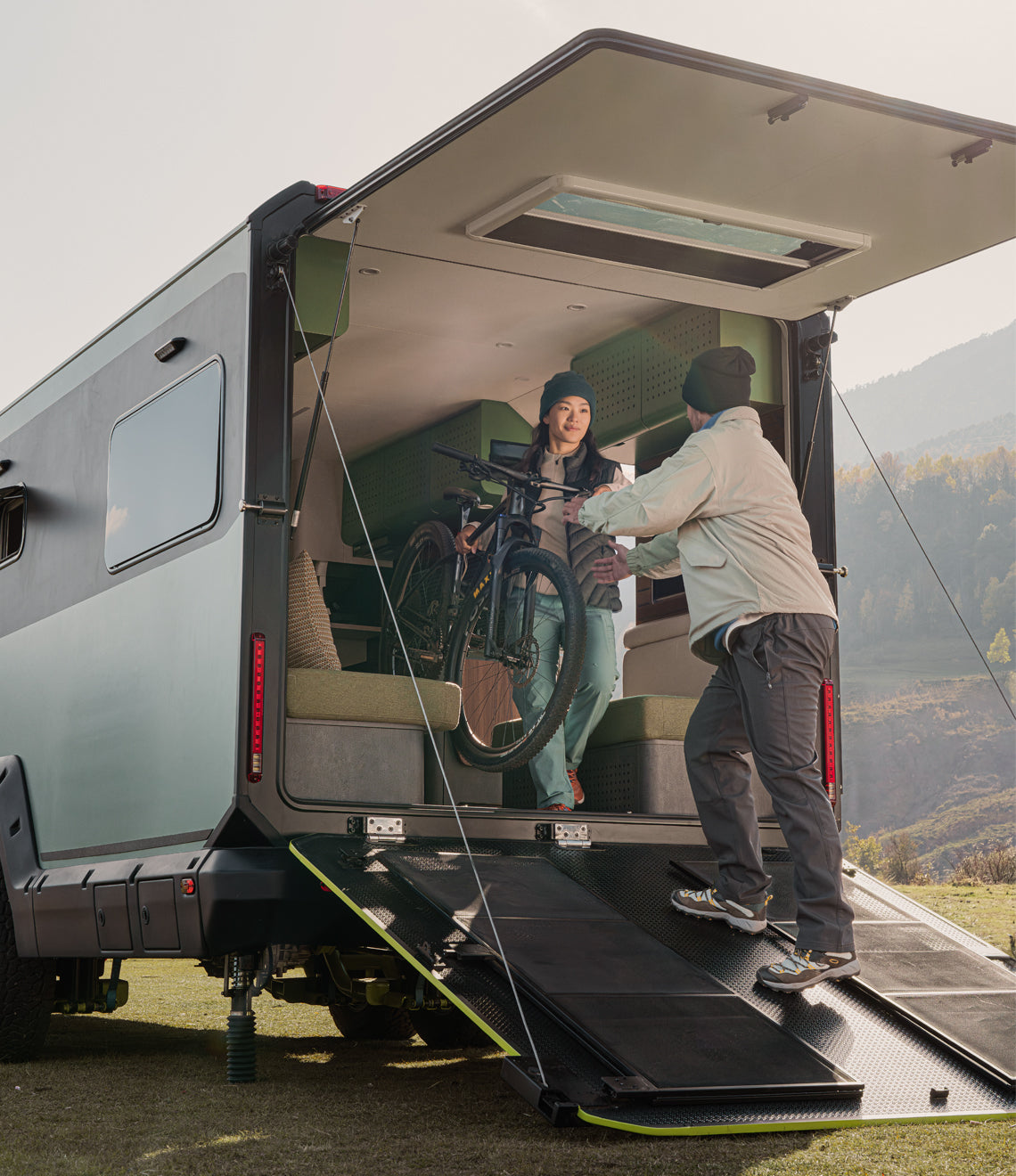
The Evotrex-PG5 is a hybrid power travel trailer built exactly on that logic. It pairs a massive LFP battery pack of 43 kWh with 1.5 kW of rooftop solar and a quiet automotive-grade gasoline generator, widely available anywhere, run as one smart integrated system delivering 270+ kWh of usable energy per cycle. Its TowSync™ adaptive tow assist is designed for electric, gas, and diesel trucks alike, and V2V power sharing means the PG5 can even share energy with an EV. Everything inside runs electric, from the induction cooktop to the heating, for 7+ days off-grid with daily HVAC use.
The distinction is worth stating plainly. The PG5 is a travel trailer with its own onboard energy system rather than an electric vehicle or a van, and that is precisely why it sidesteps the range math that constrains the van category.
The short version
Electric camper vans are real, promising, and early. Expect modest real-world range that shrinks with conversion weight, cold, and camp loads, and expect charging to shape your routes for now. If your travel stays regional and near chargers, the format can work today. If you want electric living with unrestricted range, a self-powered trailer behind the tow vehicle of your choice gets you there now, and the Evotrex-PG5 leads that path with its 43 kWh LFP battery, 1.5 kW rooftop solar, and onboard generation running as one system.
Frequently asked questions
Are electric camper vans available to buy today?
A limited number of conversions built on electric van platforms exist, alongside prototypes and preorder programs from established RV makers. The market is early, so options, specifications, and support vary widely between builders.
How far can an electric camper van go on a charge?
Real-world figures depend on the platform, the build weight, terrain, and weather, and camper conversions generally land below the base van's rating. Heating or cooling at camp draws from the same battery, which can further reduce next-day range.
Can an EV tow a travel trailer?
Yes, many electric trucks and SUVs carry substantial tow ratings. Towing reduces any vehicle's range, so trailer choice matters, and systems like TowSync™ on the Evotrex-PG5 are designed to make towing more stable and efficient for electric, gas, and diesel trucks alike.
Is the Evotrex-PG5 an electric camper van?
No. The Evotrex-PG5 is a hybrid power travel trailer, a towable RV that generates and stores its own energy with a 43 kWh LFP battery, rooftop solar, and an onboard gasoline generator. It offers fully electric living inside while being towed by whatever capable vehicle you choose.
What is the best option for off-grid electric living right now?
A trailer carrying a large dedicated energy system is the most practical route today, because it separates living power from driving range. Pairing a big battery with solar and onboard generation keeps camp running for a week or more without hookups.
By the Evotrex Travel Team. RV travelers and off-grid testers. Specs, prices, and rules change over time, so check official sources before you rely on them.