
BLM camping guide to free dispersed camping on public land
BLM camping is the closest thing American RV travel has to a free pass. The Bureau of Land Management oversees millions of acres of public land, most of it open to camping at no charge, with no reservation required and often no campground in sight. The trade is simple. You give up amenities and you get freedom, quiet, and some of the best views in the country. This guide explains how camping on BLM land works, what the rules generally look like, how to find a legal spot, and how to show up prepared.

What BLM land is
The Bureau of Land Management is a federal agency within the Department of the Interior. It manages roughly 245 million acres of public land, most of it in the western states, spanning everything from Arizona desert to high Nevada basin country. Unlike national parks, which are managed primarily for preservation and developed heavily for visitors, BLM land is managed for multiple uses. Grazing, mining, recreation, and conservation all share the same map.
For campers, that multiple-use approach is the whole appeal. Huge stretches of this land are open to dispersed camping, and a self-contained travel trailer is one of the most comfortable ways to take advantage of it. You will find everything from famous winter gathering spots like Quartzsite in Arizona to unnamed pullouts along gravel roads that never see a crowd.
How free dispersed camping works
Dispersed camping means camping outside a developed campground. There is no picnic table, no water spigot, no fee station, and usually no neighbor. In most areas there is also no cost. You find a legal spot, set up, and supply everything your rig needs on your own.
If that sounds a lot like dry camping, it is. BLM dispersed camping is the public land version of it, where the absence of hookups meets genuinely remote country.
Some BLM areas also offer developed campgrounds with vault toilets and marked sites, and a handful of desert districts run long-term visitor areas where a paid seasonal permit covers an extended stay. Here is how the options compare.
| Option | Cost | Amenities | Typical stay limit |
|---|---|---|---|
| Dispersed camping | Free in most areas | None | Often 14 days, set locally |
| Developed BLM campground | Nightly fee that varies by site | Vault toilets, sometimes water | Posted at the campground |
| Long-term visitor area | Seasonal permit fee | Varies, often dump and water access | Season length with permit |
The 14-day guideline and other BLM camping rules
The Bureau of Land Management generally allows dispersed camping in one spot for up to 14 days within a 28-day period. After that, the agency expects you to move a meaningful distance away, commonly described as about 25 miles, before camping again. Treat those numbers as general guidance rather than a universal rule. Stay limits, seasonal closures, and fire restrictions are all set locally, so the local BLM field office is the final word for any area you plan to visit.
A few rules hold nearly everywhere. Camp only where vehicles are allowed and use existing roads rather than cutting new tracks. Respect posted closures and private inholdings. Observe fire restrictions, which can change week to week during dry months. If an area is signed for day use only, it is not a campsite.
How to find legal BLM camping spots
The easiest starting points are the official ones. The maps and field office pages at blm.gov show which agency manages the ground you are looking at, and recreation.gov lists developed BLM campgrounds you can search and sometimes reserve. If you are hunting for BLM camping near you, a quick call to the field office can save an evening of guesswork, since staff know which roads are passable and where camping is currently allowed.
On the ground, look for spots that have clearly been camped before. An established clearing with an existing rock fire ring is almost always a better choice than fresh ground. Arrive with daylight to spare, walk a rough road before you tow down it, and confirm the rules whenever you are unsure whether camping is allowed.
Etiquette that keeps public land open
Free camping on public land survives on good behavior. Pack out every piece of trash, including food scraps and the little bits that blow under the rig. Camp at least 200 feet from water sources so wildlife can reach them. Use existing sites and fire rings instead of building new ones.
Keep generator hours reasonable and give neighbors far more space than a campground would. Follow Leave No Trace principles and aim to leave each site cleaner than you found it. Areas that get trashed have a way of gaining restrictions, so etiquette out here is self-interest as much as courtesy.
Staying self-sufficient on BLM land
A dispersed site offers no services at all, so your rig carries the whole load. Water comes first. Arrive with a full fresh tank, carry extra jugs, and know where your next fill and dump station are before you settle in. Grey and black water stay onboard until you reach a proper dump, and trash rides home with you.
Power is the resource that shapes how long most people can actually stay. House batteries carry the nightly load, solar puts charge back during the day, and a generator covers cloudy stretches and heavier appliances.
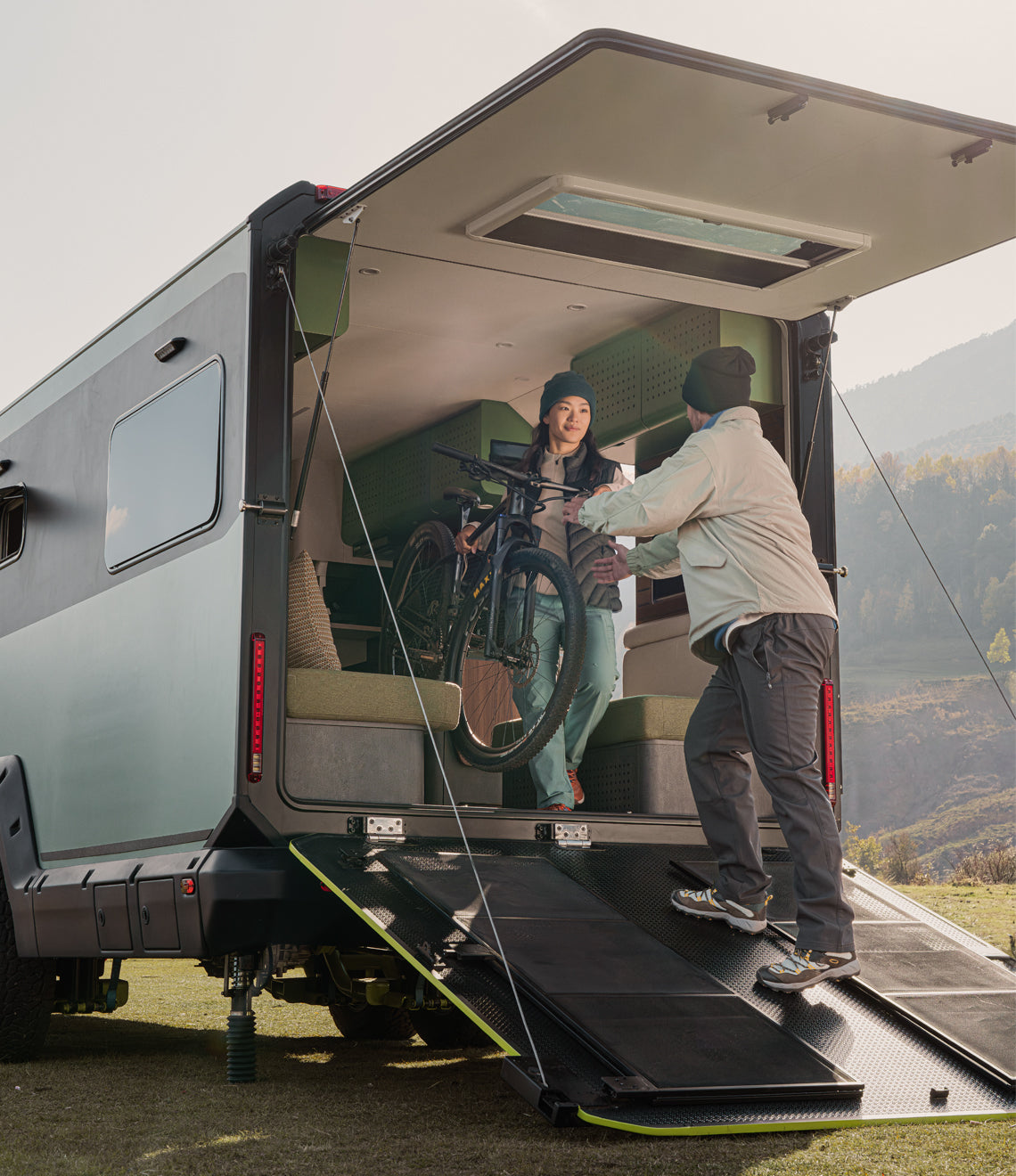
This is where the Evotrex-PG5 changes the math on a long BLM stay. It pairs a 43 kWh LFP battery with 1.5 kW of rooftop solar and a quiet automotive-grade gasoline generator, all run as one integrated system that delivers 270+ kWh of usable energy per cycle. That supports 7+ days off-grid with daily HVAC and full appliance use, which turns the two weeks that BLM land allows into comfortable camping instead of an endurance test.
The short version
BLM camping means dispersed, mostly free camping on public land managed by the Bureau of Land Management, with a general guideline of 14 days in one spot before you move along. Find legal areas through blm.gov, recreation.gov, and the local field office, camp in established sites, and pack out everything you bring in.
Self-sufficiency is the whole game, so arrive with full water, empty waste tanks, and a real plan for electricity. A trailer that generates its own power from a big battery, rooftop solar, and gasoline, like the PG5, makes the long stays that BLM land invites genuinely easy to live with.
Frequently asked questions
Is BLM camping free?
Dispersed camping on BLM land is free in most areas. Developed BLM campgrounds charge a nightly fee that varies by location, and long-term visitor areas use seasonal permits. Check recreation.gov or the local field office for specifics.
How long can you camp on BLM land?
The general guidance from the Bureau of Land Management is up to 14 days within a 28-day period in one location, followed by a substantial move before you camp again. Local field offices set the exact limits for their districts, so confirm before a long stay.
Do I need a permit for BLM dispersed camping?
Most dispersed camping requires no permit and no reservation. A few high-use areas and all long-term visitor areas do require permits, and rules change over time, so check with the field office for the area you have in mind.
How do I find BLM camping near me?
Start with the maps at blm.gov to confirm land ownership, browse recreation.gov for developed sites, and call the nearest field office for current conditions. Once you are close, established pullouts and existing fire rings mark the spots people already use.
Can you have a campfire on BLM land?
Often yes, but fire restrictions change with conditions and can prohibit open flames entirely during dry periods. Check current restrictions with the local field office before you burn, and always use an existing fire ring where one exists.
By the Evotrex Travel Team. RV travelers and off-grid testers. Specs, prices, and rules change over time, so check official sources before you rely on them.