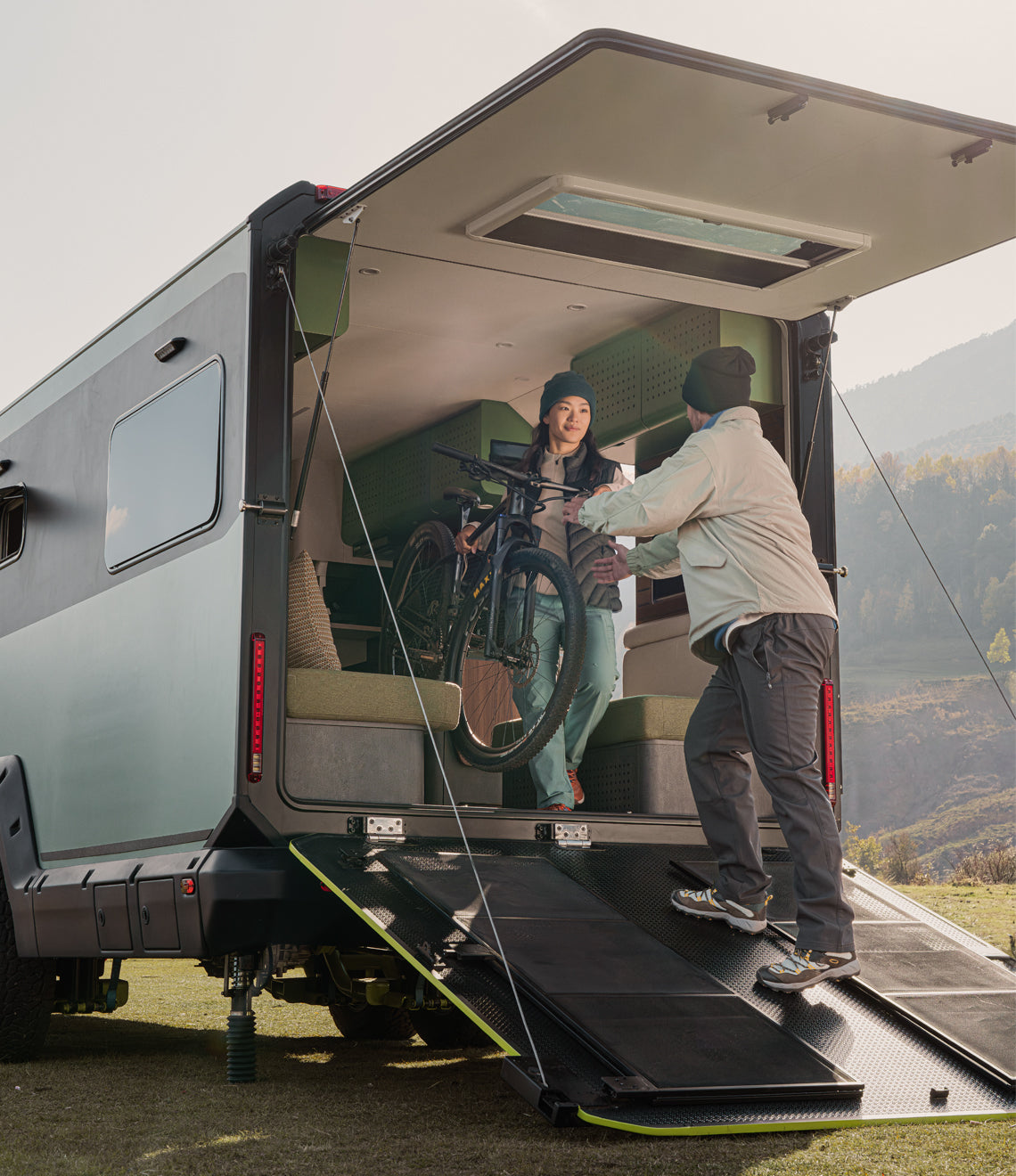

How Much Power Do You Actually Need to Boondock? Why Most All-Electric RVs Still Come Up Short

Boondocking has always sounded simple: find a beautiful place, unplug from everything, and stay as long as you want.
In reality, staying off-grid comfortably is, at its core, an energy problem — and most RVs, even the shiny new all-electric ones, still approach it like a guessing game.
At Evotrex, we decided to stop guessing.

Thank you for being here. By educating yourself on Evotrex, the PG5, and its capabilities, we can help you truly understand how much energy real off-grid living actually requires, why today’s solutions — including many “all-electric” RVs — fall short, how the Evotrex-PG5’s Integrated Power-Generating System works differently, and how our Off-Grid Calculator lets you see the math for yourself.
Did we mention the PG5 doubles as a whole-home backup generator, and can even DC fast-charge other EVs for less than public fast charging?
First, let’s start with RV Boondocking and the true issue we solved when approaching it.
The real energy cost of boondocking
Most RV energy estimates start with a battery number and stop there.
That’s the problem, friends.
Off-grid living isn’t about peak capacity — it’s about daily energy balance.
Here’s what actually consumes the most power when you’re boondocking comfortably:
- HVAC (especially electric heat and AC)
- 24/7 refrigeration
- Electric cooktops
- Hot water
- Electronics, lighting, and entertainment technology
- Water pumps, fans, RV control systems
- Charging devices such as ebikes, phones, laptops — or even another EV! (More on that below)
Even a relatively efficient setup can easily consume 15–25 kWh of battery power per day. Add climate control, colder weather, or multiple occupants, and that number can climb fast. That means a “large” 40–70 kWh battery — common in many electric RVs — doesn’t truly promise off-grid freedom… at least at the comfort levels you’re used to.
In reality, it represents one to three days, if conditions are ideal. That’s… not ideal.

Today’s solutions vary
Most off-grid RVs today fall into one of three camps: Battery Electric RVs, Solar Electric RVs, or Diesel generator-powered RVs. Before diving in, we want to point out that regardless of the RV, many campsites — especially those within National Parks — do not provide on-site electricity. As a result, viable camping options are immediately limited.
Battery Electric RVs:
These options rely on a fixed battery pack and rooftop solar panels. They are quiet and deliver clean energy, but are oftentimes limited by weather, seasons, and battery capacity. Once that battery is depleted, the party’s over. There is no recovery path aside from hightailing back to the nearest charger.
Alternatively, campers must stay at campgrounds that offer power hookups. Easier said than done.
Solar-Centric Builds:
Sure, more panels certainly help, but solar power is variable by nature. Taking into account other variables such as shorter days in the winter, cloud cover, tree shade, and even the angle of the sun, you may spend more time finding the perfect unobstructed parking spot than you do actually camping out.
Solar helps extend range, yes — but it doesn’t guarantee it.
Don’t get us wrong, we LOVE solar. It’s clean, easy, and best of all, free! But it’s also slow. Realistically you’re adding 3–4 kWh of solar power on a perfect day. That helps, but its current iteration requires additional means of power.
Traditional Diesel Generator-Based RVs:
These are the old guard. Reliable? Absolutely, but at a cost. They are loud and disconnected from modern energy systems.
While each of the solutions above solves part of the problem, none of them solves the issues as a holistic system. That is, until now.
Why the others don’t quite work, and the Evotrex-PG5 does
The core issue is simple — Most RVs treat energy as a feature. We at Evotrex treat it as infrastructure.
Battery-only systems assume ideal conditions, solar-dependent systems assume patience (and ideal conditions), and traditional generators assume you’ll tolerate noise, inefficiency, and nasty fumes.
None of them adapts dynamically to usage, integrates generation, storage, and propulsion into one system, or lets you realistically plan your off-grid stay before you even leave your home.
That’s exactly what we set out to fix. You’re welcome.

Evotrex’s solution: An Integrated Power-Generating System
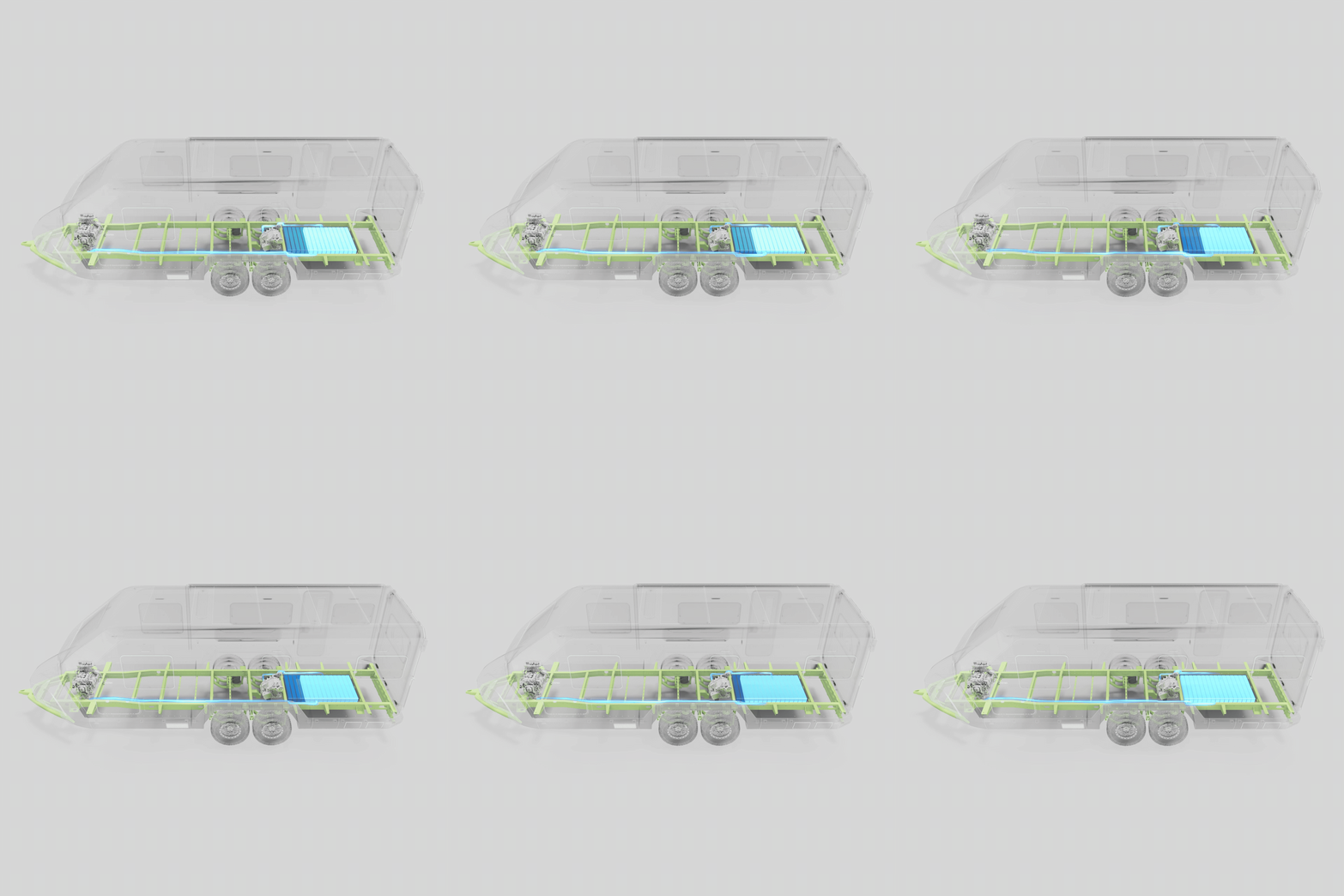
Unlike its competitors, the Evotrex PG5 does not rely on a single energy source. Instead, it utilizes the Power-Generating System — a fully integrated energy architecture that combines the following:
- 43 kWh of onboard battery storage
- 1.5 kW of rooftop solar panels
- An integrated 75 kW generator
- Electric propulsion with torque assist
- Bidirectional high-power outputs (V2L, V2V, V2H)
Travelers used to ask, “How long will my battery last?” Instead, the PG5 itself asks, “How do we keep the entire system balanced?”
The result of this integrated power-generating system is over 270 kWh of total usable energy, delivered intelligently and efficiently — whether you’re parked for a week or changing scenery every day.
The Off-Grid Calculator: No marketing math, just data
We built the Off-Grid Calculator because most RV energy claims don’t survive contact with reality. That makes it tough to prepare, and worse, tough to determine how long you can actually stay off the grid.
Don’t fret. Evotrex’s Off-Grid Calculator tool allows you to estimate and model daily energy consumption, solar contribution (depending on time of year and predicted weather), daily water usage, and net energy balance in order to determine your off-grid duration.

The Formula (simplified)
Net Energy = (Battery + Solar + Generator) — Daily Load Estimates
But the real value is transparency. We offer the tool for you to see:
- How quickly batteries deplete
- How much solar actually contributes
- How little generator runtime is needed when it’s integrated correctly

No vague “days off-grid” claims. Just physics (and some math).
The bottom line
Boondocking freedom isn’t about having the biggest battery. It’s about having a system that adapts, replenishes, and holds steady when conditions change. That’s what the Evotrex PG5 was built to do.
And now, with the Off-Grid Calculator, you don’t have to take our word for it. You can run the numbers yourself.