
RV Camping Yosemite National Park: Where to Park Your Rig (and What to Know First)
Look, RV camping near Yosemite is one of those trips that is absolutely worth it and absolutely will punish you if you wing it. The scenery is unreal. The logistics are not. So before we get into the actual campgrounds, let me set expectations like a friend who has done this a few times and watched people show up heartbroken.
Three things trip up first timers every season. One, the reservations are brutally competitive, in park sites in the Valley genuinely sell out in minutes the morning they drop.
Two, there are no hookups anywhere inside the park, none, so if you need shore power you are looking at the gateway towns. Three, the RV length limits are real and they are tight, especially in Yosemite Valley, so measure your rig honestly.
Add in a huge elevation range (the Valley floor sits around 4,000 feet, the high country pushes 8,600), a Tioga Road and Glacier Point Road that stay snowed shut into early summer, and mandatory bear food storage, and you can see why a little planning goes a long way.
The payoff: falling asleep under granite walls, no neighbors honking, the Merced River doing its thing. If you build your own power and water, you can stay in the prettiest spots in the park without a single hookup.
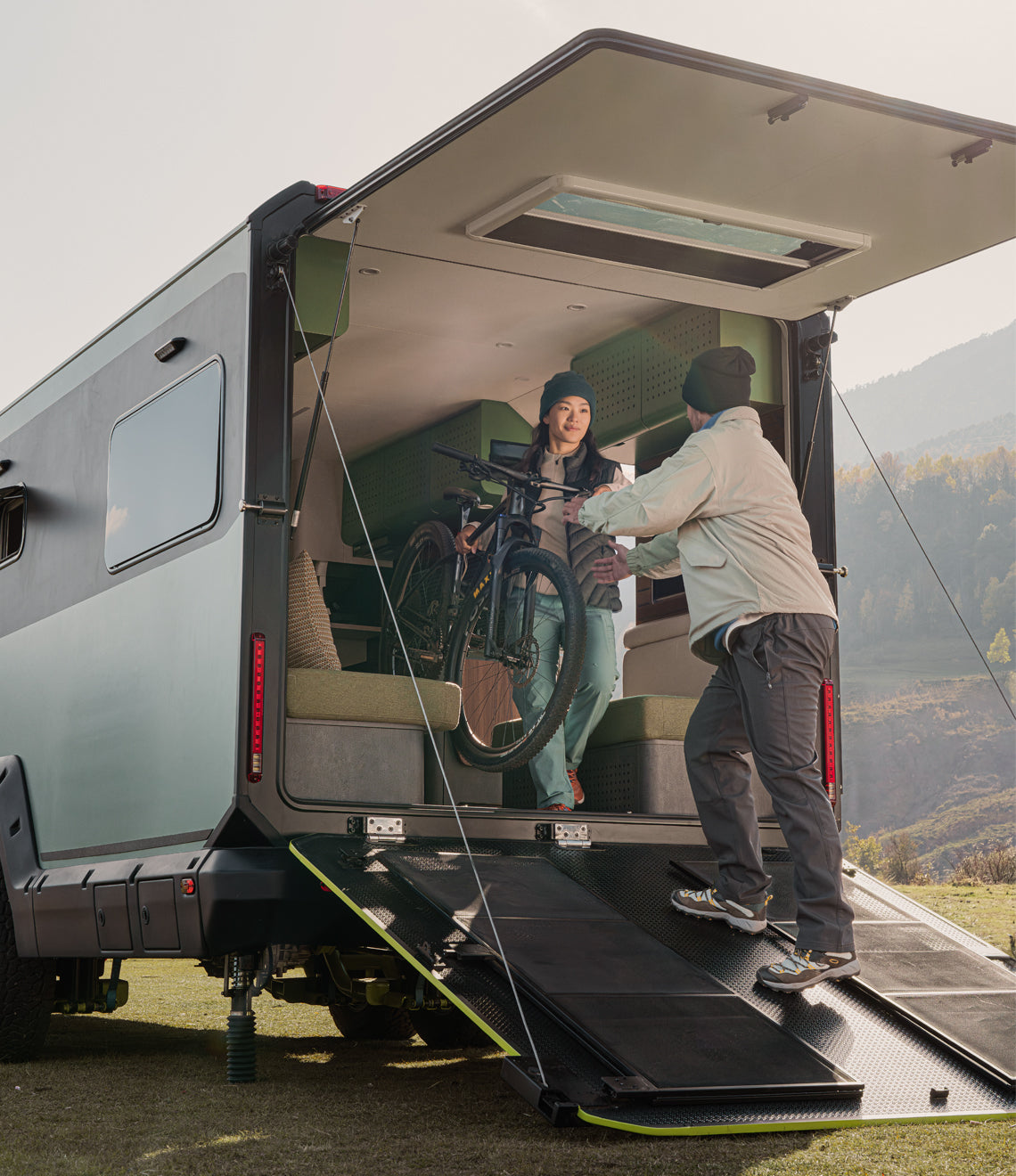
Plan it right and this becomes the trip everyone remembers. If you want a rig built for exactly that kind of off grid, self contained stay, the Evotrex-PG5 is a travel trailer designed to make its own power and water last, which is worth a look before a trip like this.

Quick Answer
For RV camping near Yosemite you have three real options: book an in park NPS campground (Upper Pines, Lower Pines, North Pines, Wawona, Hodgdon Meadow, Crane Flat, and seasonally Tuolumne Meadows), grab a full hookup site at a private RV park in a gateway town (Groveland, Mariposa, Oakhurst, El Portal, Lee Vining), or camp free on the surrounding national forest land.
There are no hookups inside the park, the best window is roughly May through September depending on elevation, and the main catch is reservation scarcity, so book the moment sites release. Good news for 2026: no entrance reservation is required to drive in, though that means even more competition for campsites.
Know the Lingo First
A few quick definitions so the rest of this makes sense:
Dispersed camping (boondocking): Camping for free on public land outside any developed campground, with no hookups, no water, and no services. Allowed on the national forests around Yosemite, never inside the park.
Full hookup vs partial vs dry camping: Full hookup means electric, water, and sewer at your site. Partial usually means electric and water but no sewer. Dry camping (also called boondocking) means none of the above, so you run on your own batteries, fresh tank, and generator.
Self contained: Your rig carries its own power, fresh water, and waste tanks, so you can stay put without plugging in. This is the only way to camp comfortably inside Yosemite.
Dump station: A spot to empty your gray and black waste tanks. Inside the park these are rare and seasonal.
Potable water: Drinkable tap water you can use to fill your fresh tank.
FCFS vs reservation: FCFS means first come, first served, you grab whatever is open when you arrive. Yosemite's RV campgrounds are reservation only, so FCFS is not your friend here.
Bear box (food locker): A metal storage locker at every site where all food and scented items must go. Required by law in the park.
Rules and What to Know First
A few things that will save your trip. Read these twice.
Book the moment reservations drop. In park reservation campgrounds release five months in advance on the 15th of each month at 7 am Pacific. Valley sites can be gone before 7:05. Be logged in and ready.
No hookups inside Yosemite. Zero electric, water, or sewer at any in park site. You run on your own batteries, generator, and fresh tank. Hookups only exist at private parks outside the park.
RV length limits vary by campground. They are stricter in the Valley and high country. Even within a campground, individual spurs differ, so read the site details on recreation.gov before you book. More on each below.
Glacier Point Road has its own RV limit. Only RVs 30 feet and shorter are allowed past Sentinel Dome or at Glacier Point, per the NPS RV page, so plan day trips accordingly.
Bear food storage is mandatory, 24 hours a day. Every site has a metal food locker. All food and toiletries go in it. Per current NPS guidance, food may be stored in a hard sided RV or trailer only if it is out of sight and the windows, doors, and vents are completely closed, and never in a pop up or soft sided camper. Rangers do enforce this.
Generator hours are limited. In park generator use is allowed only 7 to 9 am, noon to 2 pm, and 5 to 7 pm. Plan your charging and quiet hours around that.
Tioga Road and Glacier Point Road are seasonal. They close every winter and often stay closed into late June or even July. Tuolumne Meadows, White Wolf, Porcupine Flat, and Bridalveil Creek all depend on those roads being open.
No entrance reservation for 2026. Per the NPS Entrance Reservations page, no peak season day use entry reservation is required to drive into Yosemite in 2026. You still pay the standard entrance fee or use an interagency pass. With the gate open, more people compete for the same campsites, so do not relax on booking.
Overnight only in campgrounds. Sleeping in your RV outside a designated campground inside the park is not allowed, per NPS.
The Campgrounds
I broke this into three tiers: in park NPS sites, private full hookup parks in the gateway towns, and free forest camping. Pick your tier based on whether you value location, comfort, or your wallet.
Tier 1: In Park NPS Campgrounds That Take RVs
These put you inside the park. No hookups anywhere, generator hours apply, bear lockers at every site, and you book through recreation.gov. The flat per night fee at the RV campgrounds is $36 as of June 2026; always reconfirm before you book.
Upper Pines, Lower Pines, North Pines (Yosemite Valley) This is the holy grail and the hardest to get. The three Pines campgrounds sit on the Valley floor around 4,000 feet, walking distance to the Merced River and shuttle stops, with Half Dome looming overhead. Upper Pines is the only one open all year and it has the year round dump station and potable water. Lower Pines (open roughly April 21 to October 19, 2026) and North Pines (open roughly April 21 to October 26, 2026) are seasonal. Heads up: Upper Pines is closed for internal road construction May 31 to June 8, 2026, so check dates before you plan around them. North Pines also offers a lottery option in addition to the five month window. Rig fit: Upper Pines takes RVs up to 35 feet, trailers up to 24 feet. Lower Pines and North Pines take RVs up to 40 feet, trailers up to 35 feet. Paved roads, no hookups, dump station and potable water at Upper Pines year round (the Pines dump station is the Valley's only one). Cell signal in the Valley is weak and patchy, treat it as mostly dead. Elevation about 4,000 feet. Insider tip: Not every spur fits the posted maximum. The length number is the campground ceiling, not your guarantee. Open the specific site on recreation.gov and read the vehicle length for that exact spot before you commit.
Wawona Southern end of the park near the Mariposa Grove of giant sequoias, about an hour from the Valley but far less frantic. Open all year, sits along the south fork of the Merced at roughly 4,000 feet. Quieter, shadier, and a sane base if you want sequoias and a slower pace. Rig fit: RVs and trailers up to 35 feet, but spurs vary, so size matters site by site. No hookups. Dump station and potable water on site in summer only. Cell signal is spotty. Elevation about 4,000 feet. Reservable five months ahead during its reservation season (roughly April 15 to October 26, 2026). Insider tip: Wawona is your realistic backup when the Valley sells out. It books five months ahead like the rest, but it clears a hair less instantly, so it is a smart second target the morning sites drop.
Hodgdon Meadow Just inside the Big Oak Flat (Highway 120) entrance on the park's west side, open all year at about 4,900 feet. Forested and convenient if you are coming from the Groveland direction and want to be inside the boundary without driving to the Valley. Rig fit: RVs up to 35 feet, trailers up to 30 feet. No hookups, no dump station on site (use Upper Pines). Cell signal weak. Elevation about 4,900 feet. Reservable five months ahead in season. Insider tip: It is close to the entrance, which means it is your fastest in park option for an early start to the Valley before the day crowds pile in.
Crane Flat Higher up at about 6,200 feet, near the junction of Big Oak Flat Road and Tioga Road, open roughly May 21 to October 12, 2026. Cooler nights, pine forest, well placed for both the Valley and the high country once Tioga opens. Rig fit: RVs and trailers up to 35 feet. No hookups, no on site dump (nearest is Upper Pines). Cell signal poor. Elevation about 6,200 feet. Reservations open two weeks ahead for this one, not five months. Insider tip: Pack for genuinely cold nights even in summer. At 6,200 feet it drops fast after dark, and folks who packed for Valley weather end up shivering.
Tuolumne Meadows (High Country, Seasonal) The crown jewel of the high country at about 8,600 feet, deep in the subalpine meadows along Tioga Road. Season is short, typically July into late September (roughly July to September 28, 2026), and it depends entirely on Tioga Road being plowed open. If you can time it, this is some of the best scenery in the park. Rig fit: RVs up to 35 feet, trailers up to 24 feet. No hookups. Dump station and potable water on site in summer only. Cell signal effectively nonexistent up here. Elevation about 8,600 feet. Reservations are split: half release two months ahead on the 15th, half release two weeks ahead. Insider tip: At 8,600 feet the air is thin and the weather flips fast. Afternoon thunderstorms are common, nights are cold, and your generator works harder at altitude. This is exactly the kind of no hookup high country site where a self contained, power generating travel trailer like the Evotrex-PG5 lets you settle in for several quiet days without chasing a plug.
High country note: Bridalveil Creek (7,200 feet), White Wolf (8,000 feet), and Porcupine Flat (8,100 feet) also take small RVs, but limits drop fast up here. White Wolf caps RVs at 27 feet, and Porcupine Flat fits only a handful of rigs up to 24 feet with no trailers recommended. All are two week reservation windows and open only midsummer once Tioga clears.
Tier 2: Nearby Private RV Parks and Gateway Towns
This is where the hookups live. If you want 30/50 amp, sewer, and a real shower, base in a gateway town and drive in. Confirm current rates and open dates directly with each park.
Yosemite Pines RV Resort (Groveland) On Old Highway 120 in Groveland, about 24 miles from the Highway 120 entrance. Family oriented resort with full hookup sites and pull through pads that handle bigger motorhomes. Good base for the west side and the Tioga corridor. Rig fit: Full hookups (electric, water, sewer), pull through pads for large rigs, road access via Highway 120. Cell signal generally usable in town. Lower elevation than the park. Insider tip: Coming in via Highway 120 means you hit Hodgdon Meadow and Crane Flat first, so you can scout in park options without committing to the long Valley drive every day.
Indian Flat RV Park (El Portal) On Highway 140 in El Portal, about 8 miles from the Arch Rock entrance and roughly 16 miles from Yosemite Valley, making it one of the closest private parks to the Valley. It has a mix of site types, with some full hookup RV sites among a larger number of partial hookup and tent sites. Rig fit: Some full hookup sites (water, electric, sewer), others partial, so request full hookups specifically when booking. Highway 140 access is the gentlest grade into the park. Cell signal limited. Low elevation. Insider tip: The Highway 140 approach along the Merced is the easiest drive of all the entrances, which matters a lot if you are towing a big trailer and dread mountain grades.
Yosemite Lakes RV Resort (near Groveland) A Thousand Trails property just off Highway 120, often cited as roughly 5 miles from the west gate, which puts it among the closest private parks to a park entrance. Hookup sites plus cabins and amenities. Rig fit: Hookup RV sites with pull through options at a lower elevation, easy Highway 120 access. Cell signal usable. Confirm membership rules, site types, and rates directly. Insider tip: Its proximity to the Big Oak Flat entrance makes it a strong launch pad for early Valley and Tioga corridor days.
Yosemite/Mariposa KOA and area parks (Midpines/Mariposa) The Midpines and Mariposa area on Highway 140 has several private options including a KOA with full hookups and family amenities, plus the Mariposa County Fairgrounds RV area with electric and water and a year round dump station. Solid mid range base on the 140 corridor. Rig fit: Full hookups at the KOA, electric and water at the fairgrounds with an on site dump. Good road access on Highway 140. Cell signal usable. Low to mid elevation. Insider tip: Mariposa town has the last real grocery, fuel, and dump options before you commit to the park, so top off everything here.
High Sierra RV Park (Oakhurst) and Mono Vista RV Park (Lee Vining) Two ends of the park. High Sierra in Oakhurst sits on the south side near the Highway 41 entrance with full hookups and 30/50 amp service year round, good for Wawona and the south. Mono Vista in Lee Vining is on the east side near the Tioga Pass entrance and Mono Lake, full hookups and pull throughs, but seasonal (roughly April into November) since Tioga closes in winter. Rig fit: Both offer full hookups with pull through options. High Sierra is year round; Mono Vista is seasonal. Cell signal usable in both towns. Lee Vining sits high near 6,800 feet, Oakhurst is lower. Insider tip: If your plan hinges on driving Tioga Road, the Lee Vining side only works once the pass actually opens, often not until late June or July. Confirm the road is open before you book the east side.
Tier 3: Free Dispersed Camping on Adjacent National Forest
No hookups, no services, no reservations, and no fee, but you need to be self contained and you need to know the rules. Dispersed camping is not allowed inside Yosemite itself, only on the surrounding national forests. Always check the Motor Vehicle Use Map (MVUM) for the specific forest, get a California Campfire Permit, check current fire restrictions, and call the relevant ranger district if you are unsure where camping is permitted.
Hardin Flat Road area (Stanislaus National Forest, near Groveland) Off Highway 120 west of the park, this corridor on Stanislaus National Forest allows dispersed camping for up to 14 days at a time. Convenient for the Big Oak Flat entrance. Rig fit: Forest dispersed, no hookups, no water, no dump, road quality varies so smaller and higher clearance rigs do best. Cell signal mostly dead. Mid elevation. Insider tip: Call the Groveland Ranger District (209 962 7825) to confirm current conditions and exactly which spurs are open before you head in, because closures shift with fire season.
Owens River Road area (Inyo National Forest, near Lee Vining/Mammoth) On the east side between Lee Vining and Mammoth Lakes, this is classic eastern Sierra dispersed camping, roughly a half hour to an hour from the Tioga Pass entrance. Per the Inyo National Forest camping page, you may camp up to 14 consecutive days in one location and up to 28 days per calendar year, and after 14 days you must relocate at least 10 miles away. Rig fit: Forest dispersed, no services, open high desert sites that handle larger rigs better than tight forest roads. Cell signal patchy. High elevation, cold nights. Insider tip: Download the Inyo National Forest map in the Avenza Maps app and check the closure map before you pick a spot, since some areas are off limits and it is not always obvious on the ground.
Summit area (Sierra National Forest, south of the park) South of Yosemite in Sierra National Forest, the Summit dispersed area is a designated camping zone, so you know camping is actually permitted there. Good base for the Highway 41 south entrance and the sequoias. Rig fit: Forest dispersed, no hookups or services, durable surfaces only, road access varies. Cell signal weak to none. Mid to high elevation. This is another spot where a self contained, power generating travel trailer like the Evotrex-PG5 shines, since you are fully off hookups and want to stay a while. Insider tip: Camp on already cleared durable ground, stay on established roads, and keep at least 200 feet from any water source. Pack out everything and store food like you are in bear country, because you are.
At a Glance
| Campground | Tier / Type | Hookups | Max RV Length | Reservation | Season (2026) |
|---|---|---|---|---|---|
| Upper Pines | Tier 1 NPS (Valley) | None | 35 ft | 5 months ahead | All year |
| Lower Pines | Tier 1 NPS (Valley) | None | 40 ft | 5 months ahead | Apr 21 to Oct 19 |
| North Pines | Tier 1 NPS (Valley) | None | 40 ft | 5 months / lottery | Apr 21 to Oct 26 |
| Wawona | Tier 1 NPS | None | 35 ft | 5 months ahead | All year |
| Hodgdon Meadow | Tier 1 NPS | None | 35 ft | 5 months ahead | All year |
| Crane Flat | Tier 1 NPS | None | 35 ft | 2 weeks ahead | May 21 to Oct 12 |
| Tuolumne Meadows | Tier 1 NPS (high country) | None | 35 ft | 2 months / 2 weeks | Jul to Sep 28 |
| Yosemite Pines RV Resort | Tier 2 private (Groveland) | Full | Large rigs OK | Direct with park | Check directly |
| Indian Flat RV Park | Tier 2 private (El Portal) | Full (some sites) | Varies | Direct with park | Check directly |
| Forest dispersed | Tier 3 forest | None | Varies by road | None | Varies |
Check Before You Roll
Conditions, dates, and closures change, so verify everything against the official sources before you go. These were all live during research in June 2026.
Before you commit to anything, personally confirm these specifics for your dates, because they shift and they make or break the trip:
The 2026 closure window on Upper Pines (closed May 31 to June 8, 2026), since dates can move.
Exact 2026 opening and closing dates for the seasonal campgrounds (Lower Pines, North Pines, Crane Flat, Tuolumne Meadows and the rest of the high country).
The current entrance and day use reservation status for 2026 (reported as not required), since park policy can change.
Reservation lead times, especially Crane Flat (two weeks) and Tuolumne Meadows (half two months, half two weeks).
Per campground RV length limits, hookup details, and dump and water availability, which vary site by site and season to season, plus the 30 foot RV limit on Glacier Point Road.
Whether Tioga Road and Glacier Point Road are actually open for your window, since the high country depends on it.
For forest dispersed camping, current legality and rules for your spot (the 14 and 28 day limits, MVUM, campfire permit, and any active closures).
Current per night fees ($36 at the in park RV campgrounds as of June 2026).
And the official sources to check it all against:
- Visiting Yosemite with an RV
- Yosemite campgrounds overview
- Yosemite campground reservations and release schedule
- Yosemite entrance reservations (2026 status)
- Book in park sites (recreation.gov Yosemite gateway)
- Upper Pines on recreation.gov
- Sierra National Forest (south of the park)
- Stanislaus National Forest (Highway 120 west, Groveland Ranger District 209 962 7825)
- Inyo National Forest (east side, Tioga/Mono) camping and dispersed rules
For forest dispersed camping, pull the MVUM for that forest and use the Avenza Maps app to confirm where camping is allowed. When in doubt, call the ranger district directly.
FAQ
Can you RV camp in Yosemite? Yes. Several in park NPS campgrounds take RVs, including Upper Pines, Lower Pines, North Pines, Wawona, Hodgdon Meadow, Crane Flat, and seasonally Tuolumne Meadows. You book through recreation.gov, and the in park sites have no hookups.
Does Yosemite have RV hookups? No. There are no electric, water, or sewer hookups at any campsite inside Yosemite. For full hookups you stay at a private RV park in a gateway town like Groveland, El Portal, Mariposa, Oakhurst, or Lee Vining.
What is the RV length limit in Yosemite? It varies by campground. Upper Pines allows RVs up to 35 feet, while Lower Pines and North Pines allow up to 40 feet. Wawona, Hodgdon Meadow, Crane Flat, and Tuolumne Meadows top out around 35 feet, and the high country drops lower. Individual spurs are often shorter than the posted maximum, so check the exact site on recreation.gov. Note that only RVs 30 feet and shorter are allowed past Sentinel Dome or at Glacier Point.
Is there free camping near Yosemite? Yes, on the surrounding national forests, not inside the park. Sierra, Stanislaus, and Inyo national forests allow free dispersed camping (typically up to 14 days at one spot) in many areas. Check the MVUM, get a California Campfire Permit, and call the ranger district to confirm where it is allowed.
Do I need an entrance reservation for Yosemite in 2026? No. Per the NPS, no peak season day use entrance reservation is required to drive into Yosemite in 2026. You still pay the standard entrance fee or use an interagency pass, and demand for campsites is high, so book early.
When is the best time to RV camp near Yosemite? Late spring through early fall, roughly May to September, depending on elevation. The Valley campgrounds run longest, while high country sites like Tuolumne Meadows only open once Tioga Road clears, often not until late June or July. Summer is busiest and books out hardest.
Things to Watch Out For
A few last realities that bite people.
Water and dump logistics: the only year round in park dump station and potable water is at Upper Pines. Wawona and Tuolumne Meadows have dump stations and water in summer only. Fill your fresh tank and dump when you can, because options are limited once you are inside the park.
Apps that genuinely help out here: Campendium, iOverlander, and The Dyrt for finding and vetting sites and dump stations, plus the Avenza Maps app loaded with the forest MVUM for any dispersed camping.
Hazards to plan around:
Reservation scarcity, in park Valley sites sell out in minutes the morning they release five months ahead.
No hookups inside the park, you run fully on your own power and water.
RV length limits by campground and even by spur, measure honestly and read the exact site.
Bears and food storage, use the locker, and only store food in a hard sided rig that is closed up and out of sight.
Elevation range, from about 4,000 feet in the Valley to 8,600 in the high country, with cold nights and thinner air up high.
Tioga and Glacier Point Road seasons, the high country can stay closed into late June or July.
Fire and smoke restrictions, summer fire bans and wildfire smoke happen, check current conditions and any campfire rules before you go.
Cell dead zones, signal is weak to nonexistent across most of the park and the forests, so download maps and reservations offline.