
RV Camping Near Shenandoah National Park: In Park, Nearby, and Free Sites
Here is the thing about RV camping near Shenandoah National Park: almost everything strings along one road. Skyline Drive runs 105 miles down the spine of the Blue Ridge, and the park campgrounds that take rigs all sit right off it. That makes trip planning simple and a little sneaky at the same time. The speed limit is 35 mph the whole way, there are tunnels and curves, and fuel options inside the park are thin, so a 50 mile day eats more time and gas than you expect. Plan your fill ups before you climb.
The big catch for RVers is hookups, or rather the total lack of them. None of the in park campgrounds have electric, water, or sewer at the site. Every one of them is dry camping on a mountaintop. The good news is the season is milder and longer feeling than the big western parks, the campgrounds run roughly spring through late fall, and the foliage in October is genuinely worth the hype. The bad news is everybody knows that, so October weekends book out and reservations matter. Black bears are active here too, so food storage is not optional.
If you want power and a sewer connection, you sleep outside the park near Luray, Front Royal, Elkton, or Waynesboro and drive up for the day. If you want free and quiet, the surrounding George Washington National Forest offers dispersed camping. Below I break it into three tiers so you can match your rig and your mood.

Quick Answer
You can RV camp inside Shenandoah at four campgrounds along Skyline Drive (Mathews Arm, Big Meadows, Lewis Mountain, and Loft Mountain), but none have hookups, so you are dry camping with dump stations and potable water on site. For power and sewer, stay at a private or state park campground near Luray, Front Royal, or Waynesboro and drive up. For free camping, head to dispersed sites in the George Washington National Forest nearby. The best season is spring through October, and the main catch is no in park power plus fall foliage crowds.
Quick Definitions
Before you book, get these four terms straight. They decide which tier fits your rig.
Full hookups: A site with water, electric, and sewer connections piped right to your pad. This is what private and state park campgrounds outside Shenandoah offer. No in park site has it.
Dry camping: Camping with no hookups at the site, running off your fresh water tank and onboard power. Every Shenandoah campground is dry camping, though most have a shared dump station and potable water fill.
Boondocking: Dry camping out on undeveloped public land, away from any facilities, fully self contained. Think a quiet forest road in the national forest.
Dispersed camping: The official Forest Service term for free, primitive camping outside developed campgrounds, on existing roads and previously used sites. It is boondocking with rules attached.
Rules and What to Know First
No hookups inside the park. All four in park campgrounds are dry camping. No electric, no water, no sewer at any site. Plan to run off your batteries, solar, or generator. (Source: NPS Shenandoah Campgrounds)
RV length limits vary by campground and by site. Big Meadows and Loft Mountain handle the larger rigs at many sites, Mathews Arm fits a wide range, and Lewis Mountain is small and tight, better for shorter rigs and vans. Sources disagree on exact maximums, so always check the per site vehicle length on recreation.gov before you book.
Skyline Drive is 35 mph for 105 miles. Watch Marys Rock Tunnel near milepost 31.5, with a posted maximum clearance of 12 feet 8 inches in both lanes. (Source: NPS Driving Skyline Drive)
Fall foliage means reservations. October weekends fill fast. Big Meadows is reservation only, with no walk ups. Book early on recreation.gov.
Bear country, store your food. Keep food and coolers inside your rig or in provided storage, never out at the site.
Seasonal only. No campground is open year round. For 2026, Big Meadows opened March 25 and Lewis Mountain March 26, while Mathews Arm and Loft Mountain opened April 29. Closing dates were still listed as to be determined, so confirm current dates. (Source: NPS Operating Hours and Seasons)
The Campgrounds
Tier 1: In Park NPS Campgrounds Along Skyline Drive
All four sit directly on Skyline Drive, all are dry camping with no hookups, and all are seasonal. Mileposts increase north to south.
Mathews Arm Campground Nearest town: Luray, VA. What it is: NPS campground at milepost 22.1 in the north district, with nearly 166 sites. It is the closest of the four to the Front Royal entrance, so it is a solid first night if you are coming from the north. Quiet, wooded, and a good base for Overall Run Falls. Rig fit: A wide range of sites, paved campground roads. No hookups. One dump station with potable water on site. Cell signal is spotty, expect dead zones. Insider tip: It has a mix of reservable and first come sites, so if you strike out online you can still try rolling in midweek. Book the dump run for your way out since the next reliable one south is at Big Meadows.
Big Meadows Campground Nearest town: Luray, VA, via Thornton Gap. What it is: NPS campground at milepost 51 in the central district, the busiest and most amenity rich. Showers, a camp store, a wayside, and the Byrd Visitor Center are all right here, plus the open meadow itself for sunset and wildlife. If it is your first time, this is the easy button. Rig fit: Many sites handle larger rigs, but lengths vary site to site so check each listing. No hookups. Dump and fill station with potable water on site. Reservation only, no walk ups. Cell signal is better here than most of the park but still patchy. Insider tip: This is reservation only and it is the first to fill in October, so set a reminder when the booking window opens. Note that road and paving work has happened here in recent seasons, so check for any site closures before you count on a specific loop.
Lewis Mountain Campground Nearest town: Elkton, VA. What it is: a small NPS campground around milepost 57.2 in the central district, first come first served only. The most low key and woodsy of the four, and it usually has space except on holiday weekends and peak October. Showers and a small camp store are on site. Rig fit: Small sites with tight turns, best for shorter rigs and vans, not your 40 footer. No hookups. No dump station here, the nearest dump and water is at Big Meadows to the north. Cell signal is weak. Insider tip: Because it is first come only, you have to physically arrive to claim a site. Show up earlier in the day on a Friday in fall and you can often grab the quietest in park spot in the park.
Loft Mountain Campground Nearest town: Elkton, VA, near Swift Run Gap. What it is: the largest in park campground, around milepost 79.5 in the south district, sitting high on Big Flat Mountain with big views. Trails like the Loft Mountain Loop and access to the Appalachian Trail are right there, and pay showers and a camp store are nearby. Rig fit: Handles larger rigs at many sites, but lengths vary so confirm per site. No hookups. Dump station with potable water about a quarter mile from the campground. Mix of reservable and first come sites. Cell signal is unreliable. Insider tip: Generators are only allowed during set hours, currently 8 a.m. to 10 a.m. and 4 p.m. to 7 p.m., extended to 9 p.m. from October 15 to the end of the season for heat, so if you rely on one for morning coffee, plan around the window. (Source: NPS Loft Mountain Campground) The exposed sites mean great sunsets and also more wind and fog, so level and chock well.
For longer dry camping stays where generator hours are tight, an internal explainer on managing power off grid is handy.
Tier 2: Nearby Private and State Park Campgrounds with Hookups
This is where you go for power, sewer, longer stays, and laundry. You trade the mountaintop for hookups and drive up to Skyline Drive for the day.
Shenandoah River State Park, Bentonville Nearest town: Front Royal, VA, about 8 miles north of the park and 15 miles north of Luray. What it is: a Virginia state park along the river with a developed RV loop, a strong value pick near the Front Royal entrance to Skyline Drive. Rig fit: 31 sites with water and electric, offering 20, 30, and 50 amp service. Twenty six back in sites and five pull throughs, fitting rigs up to 60 feet. Centrally located restrooms with hot showers. No sewer at the site, so use the dump station. Reservations strongly advised in summer and fall. Recent rates ran about 40 dollars per night for Virginia residents and 46 dollars for non residents, so confirm current pricing. (Source: Virginia DCR Shenandoah River State Park) Insider tip: This is your best budget hookup base near the north entrance. Book early for fall, the riverfront and electric loop go fast.
Yogi Bear's Jellystone Park, Luray Nearest town: Luray, VA, near the Thornton Gap entrance. What it is: a private family resort on a large property with concrete pads, full hookup and pull through sites. Family heavy with pools and activities, and close to Luray Caverns. Roughly a 30 minute drive to the Thornton Gap entrance. Rig fit: Full hookup pull through and back in sites. Paved and graded roads suited to big rigs. Water, electric, sewer. On site amenities and store. Cell and wifi available. Insider tip: Great basecamp if you have kids, but it books up in summer and fall, so reserve ahead and ask for a concrete pad site if you want easy leveling.
Waynesboro North 340 Campground Nearest town: Waynesboro, VA, near the Rockfish Gap entrance. What it is: a private campground in the heart of the Blue Ridge about 9 miles from Rockfish Gap, which is the southern Skyline Drive entrance and the start of the Blue Ridge Parkway. Perfect if you want to combine both scenic drives. Rig fit: Full hookup RV sites. Paved access off Route 340. Water, electric, sewer. Cell coverage solid in Waynesboro. Insider tip: Stage here if your plan is to run Skyline Drive south to north or roll straight onto the Blue Ridge Parkway, it saves you a long backtrack.
Tier 3: Free Dispersed Camping on the National Forest
Surrounding Shenandoah is the George Washington National Forest, where dispersed camping is free and legal in many spots outside developed areas. This is true self contained territory, no hookups, no water, no dump, pack it in and pack it out. It is also where a power generating rig earns its keep.
Braley Pond Dispersed and Day Use Area Nearest landmark: near Staunton, VA, in the George Washington National Forest, roughly an hour from the park. What it is: a popular primitive dispersed and day use area, a good well known entry point into forest camping that is still drivable for many rigs. Rig fit: Primitive forest roads, so scout access for your length before committing, better for smaller and mid size rigs and vans. No hookups, no water, no dump. Cell signal often none. Insider tip: Arrive with full fresh water and empty tanks since there is nothing out here, and keep your site within 150 feet of the road and at least 100 feet from water per forest rules.
General forest road dispersed corridors Nearest landmark: George Washington National Forest west and south of the park. What it is: scattered free dispersed sites along forest roads. The forest allows camping up to 14 days in any 30 day period, on existing roads, within 150 feet of a roadway and at least 100 feet from streams. (Source: USFS George Washington and Jefferson National Forests Camping) Rig fit: Forest service roads range from easy gravel to rough and narrow, so a Motor Vehicle Use Map is essential to know what is open and drivable. No hookups, no water, no dump. Cell signal unreliable to none. Insider tip: Download the official Motor Vehicle Use Map (MVUM) for the district before you lose signal, and call the local ranger district to confirm current conditions and any fire restrictions. When in doubt, do not guess, ask the ranger.
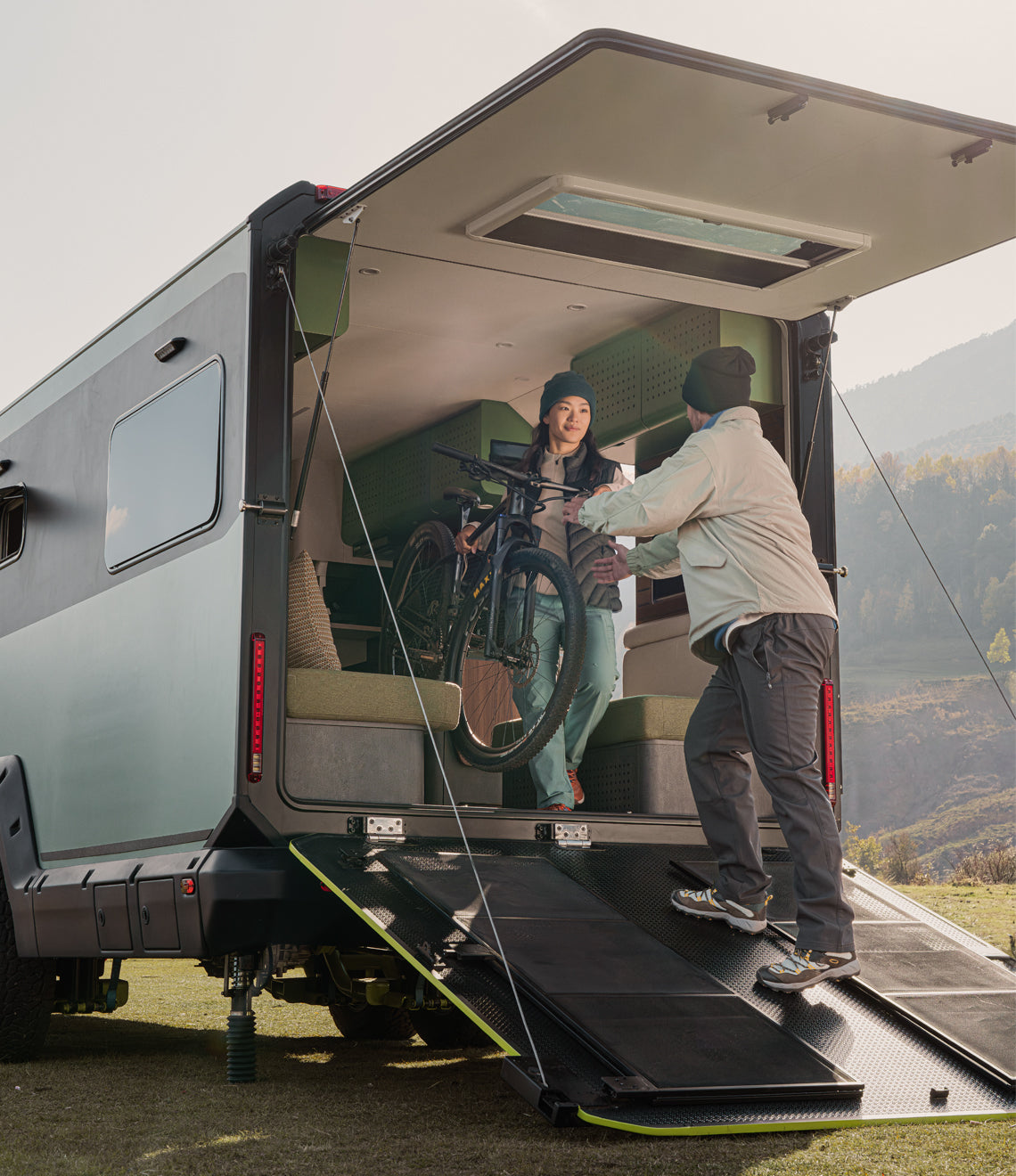
This is also exactly the kind of place a rig like the Evotrex-PG5 shines. It is a travel trailer built to make its own power from a large lithium battery bank, integrated solar, and an onboard gasoline generator, which is the right tool when you are dry camping a mountaintop loop like Big Meadows or tucked into a forest road with zero hookups for days. Worth a look if staying off hookups longer is your style. See the lineup at the Evotrex homepage.
| Campground | Tier / Type | Hookups | Reservation | Season |
|---|---|---|---|---|
| Mathews Arm | Tier 1 / NPS in park | None | Reservable plus first come | Seasonal, opened Apr 29 in 2026 |
| Big Meadows | Tier 1 / NPS in park | None | Reservation only | Seasonal, opened Mar 25 in 2026 |
| Lewis Mountain | Tier 1 / NPS in park | None | First come only | Seasonal, opened Mar 26 in 2026 |
| Loft Mountain | Tier 1 / NPS in park | None | Reservable plus first come | Seasonal, opened Apr 29 in 2026 |
| Shenandoah River State Park | Tier 2 / State park | Water and electric | Reservation advised | Year round |
| Yogi Bear's Jellystone, Luray | Tier 2 / Private | Full hookup | Reservation | Open per resort |
| Waynesboro North 340 | Tier 2 / Private | Full hookup | Reservation | Open per resort |
| Braley Pond and forest dispersed | Tier 3 / Forest dispersed | None | None, 14 day limit | Year round, weather permitting |
Things to Watch Out For
Water fill and dump locations: inside the park, plan around the dump and potable water stations at Mathews Arm, Big Meadows, and near Loft Mountain. Lewis Mountain has none, so dump at Big Meadows to the north. Arrive with full fresh water and dump on your way out, do not assume there is a station around the next bend.
Useful apps: Campendium, iOverlander, and The Dyrt are all handy for verifying current site lengths, road access, and recent reviews before you commit, especially for the forest dispersed spots where conditions change.
Hazards to plan for:
No hookups in the park. You are dry camping every night inside Shenandoah, so manage your power and water.
Skyline Drive speed and length. 35 mph for 105 miles plus curves and tunnels means slow going, watch the 12 foot 8 inch clearance at Marys Rock Tunnel near milepost 31.5.
Fall foliage crowds. October weekends pack out, book early and expect traffic on the Drive.
Bears and food storage. Active black bears, keep all food and coolers inside, never at the site.
Fog. Mountaintop campgrounds and the Drive can sock in fast, slow down and use low beams.
Cell dead zones. Coverage is spotty to none across much of the park and forest, download maps offline.
Fire restrictions. Conditions change, check current fire rules with the park or the ranger district before any campfire.
Check Before You Roll
Verify these live before your trip, conditions and dates change every season:
- Shenandoah camping overview
- Driving Skyline Drive (entrances, mileposts, clearances)
- Operating hours and seasonal dates
- Reservations and booking (search the specific campground)
- George Washington and Jefferson National Forests camping
For forest dispersed camping, get the Motor Vehicle Use Map (MVUM) for the ranger district and load it offline with the Avenza Maps app. When anything is unclear, call the local ranger district directly.
A few specifics worth confirming for yourself before you go, since they shift by season and by rig:
Exact 2026 open and close dates for each in park campground. Big Meadows and Lewis Mountain opened in late March, Mathews Arm and Loft Mountain on April 29, but closing dates were still pending, so check nps.gov/shen and recreation.gov for your travel window.
The per site RV length limit at your campground. Big Meadows and Loft Mountain take the larger rigs at many sites, Mathews Arm fits a range, and Lewis Mountain is small with tight sites. Pull up the exact site listing on recreation.gov, since published maximums vary by source.
The Marys Rock Tunnel clearance near milepost 31.5, posted at 12 feet 8 inches, against your rig height.
Hookups, dump, and water at your stops, plus drive distances if you base outside the park (Shenandoah River State Park about 8 miles south of Front Royal, Jellystone around 30 minutes to Thornton Gap, Waynesboro North 340 about 9 miles from Rockfish Gap). Confirm current details and pricing on each campground's site.
Forest road access for your length before you commit to a dispersed spot like Braley Pond, and scout it rather than guess.
Skyline Drive conditions, any road or paving closures, reservation windows, and current dispersed camping rules and fees for the ranger district you are headed to.
FAQ
Can you RV camp in Shenandoah National Park? Yes. Four campgrounds along Skyline Drive take RVs: Mathews Arm, Big Meadows, Lewis Mountain, and Loft Mountain. All are dry camping with dump stations and potable water, except Lewis Mountain, which uses Big Meadows for dumping.
Does Shenandoah have RV hookups? No. None of the in park campgrounds offer electric, water, or sewer hookups at the site. For hookups you need a campground outside the park, such as Shenandoah River State Park near Front Royal (water and electric) or a private resort near Luray or Waynesboro (full hookup).
What is the RV length limit at Shenandoah campgrounds? It varies by campground and by site. Big Meadows and Loft Mountain accommodate larger rigs at many sites, Mathews Arm fits a wide range, and Lewis Mountain is small with tight sites, best for shorter rigs. Published maximums differ between sources, so always check the per site vehicle length on recreation.gov.
Is there free camping near Shenandoah? Yes. The surrounding George Washington National Forest allows free dispersed camping outside developed areas, up to 14 days in any 30 day period, within 150 feet of a road and at least 100 feet from water. There are no hookups, water, or dump stations, so come self contained and use the MVUM.
When is the best time to RV camp at Shenandoah? Spring through fall. The campgrounds run roughly late March or late April into late fall, weather permitting. October foliage is spectacular but crowded and requires early reservations, while late spring and September offer great weather with thinner crowds.
Can I run a generator at the in park campgrounds? Yes, during posted hours. At Loft Mountain, for example, generators are currently allowed 8 a.m. to 10 a.m. and 4 p.m. to 7 p.m., extended to 9 p.m. from October 15 to the end of the season for heat, and not at all in generator free or group sites. Hours can vary by campground and season, so confirm before you go.