
Dispersed Camping in Wyoming: Where to Go and How to Do It Right
Wyoming is loaded with public land, from the sagebrush basins managed by the government to vast national forests wrapped around the Tetons, Yellowstone, and the Bighorns. Dispersed camping means camping for free on that public land outside a developed campground, with no hookups, no water, and no services. This guide covers where it is allowed, the rules that keep you legal, the strongest regions to aim for, and how to come prepared so a night far from any power pedestal is comfortable rather than stressful.

Where dispersed camping is allowed in Wyoming
Most free camping in Wyoming happens on two kinds of public land: national forests managed by the US Forest Service, and land managed by the Bureau of Land Management. The forests include some of the biggest in the lower 48, and the state has millions of acres of open BLM country between them.
On most national forest and BLM land, dispersed camping is free and needs no permit. The catch is that every forest and field office can set its own rules, so a spot that is wide open in one district may be limited to designated sites in the next. One important note: Grand Teton and Yellowstone national parks do not allow dispersed camping. Inside the parks you must use a developed campground or a backcountry permit, so the free camping happens on the surrounding forests and BLM land instead.
The rules every Wyoming dispersed camper needs to know
A few rules apply almost everywhere, and knowing them keeps you out of trouble.
Stay limit. Limits vary by manager. On BLM land the standard is 14 days within any 28 day period, after which you move to a new area, often 25 to 30 miles away. National forests set their own version: the Bridger Teton National Forest allows 14 days in any 30 day period within a 5 mile radius, then requires you to move 5 air miles and stay out of that radius for 30 days.
Watch for tighter limits near Jackson. The high traffic corridors around Jackson and the Tetons have tightened over years of overuse. In the Jackson, Blackrock, Big Piney, and Greys River districts, camping drops to a 5 day maximum from May 1 through Labor Day. Popular areas such as Shadow Mountain are now managed as designated dispersed sites, so park where you want camping is no longer allowed there.
Stay on established roads and sites. Keep motor vehicles within about 150 feet of a designated route and use existing pullouts and fire rings rather than making new ones. Driving off road to reach a view causes lasting damage and is prohibited.
Keep your distance from water. Camp at least 200 feet from lakes, rivers, and streams, and away from trailheads and developed recreation areas.
Store food for bears. Much of western and northern Wyoming is grizzly country. Forests here require you to secure all wildlife attractants, including food, trash, and dishes, in a hard sided vehicle or an approved container so wildlife cannot reach them.
Check fire restrictions. Wyoming dries out fast in summer, and counties and field offices post fire restrictions that can ban open campfires entirely. Always look up the current restrictions for your exact area before you plan a fire, and carry a stove as a backup.
Best regions for dispersed camping in Wyoming
Bridger Teton National Forest (Jackson and the Tetons). One of the largest forests in the country, wrapped around Grand Teton National Park. Expect stunning primitive sites with no facilities, plus the tightest rules in the state near Jackson. Arrive early, because designated areas fill by late morning in summer.
Shoshone National Forest (east of Yellowstone). The country's first national forest stretches from the Yellowstone gateway near Cody down to the Wind River Range. Forest roads deliver classic mountain dispersed camping in summer. This is deep bear country, so attractant storage is not optional.
Bighorn National Forest (north central Wyoming). A high forest island above the plains near Sheridan and Lovell. It now enforces a 14 day within 28 day stay limit year round, with a 5 road mile move required before you return, and a wildlife attractant storage rule.
BLM lands (Cody, Lander, and the basins). Between the forests, open BLM country gives you high desert camping that is often snow free earlier and later in the year. Standard dispersed sites need no permit, but confirm the local field office rules.
| Region | Land manager | Best season | Hookups | Good to know |
|---|---|---|---|---|
| Bridger Teton NF | US Forest Service | Summer to early fall | None | 5 day limit near Jackson, May 1 to Labor Day |
| Shoshone NF | US Forest Service | Summer to fall | None | Grizzly country, store all attractants |
| Bighorn NF | US Forest Service | Summer to fall | None | 14 days in 28, move 5 road miles |
| BLM lands | BLM | Late spring to fall | None | Move 25 to 30 miles after 14 days |
High country, cold nights, steady power
Wyoming dispersed camping is high, cold at night, and often windy, and the season is short. All of that pulls harder on your power than a mild trip would, whether you are heating up in the morning or keeping the fridge going through a chilly Bighorn evening. Water and waste are routine. Steady power in thin, cold air is the part to plan for.
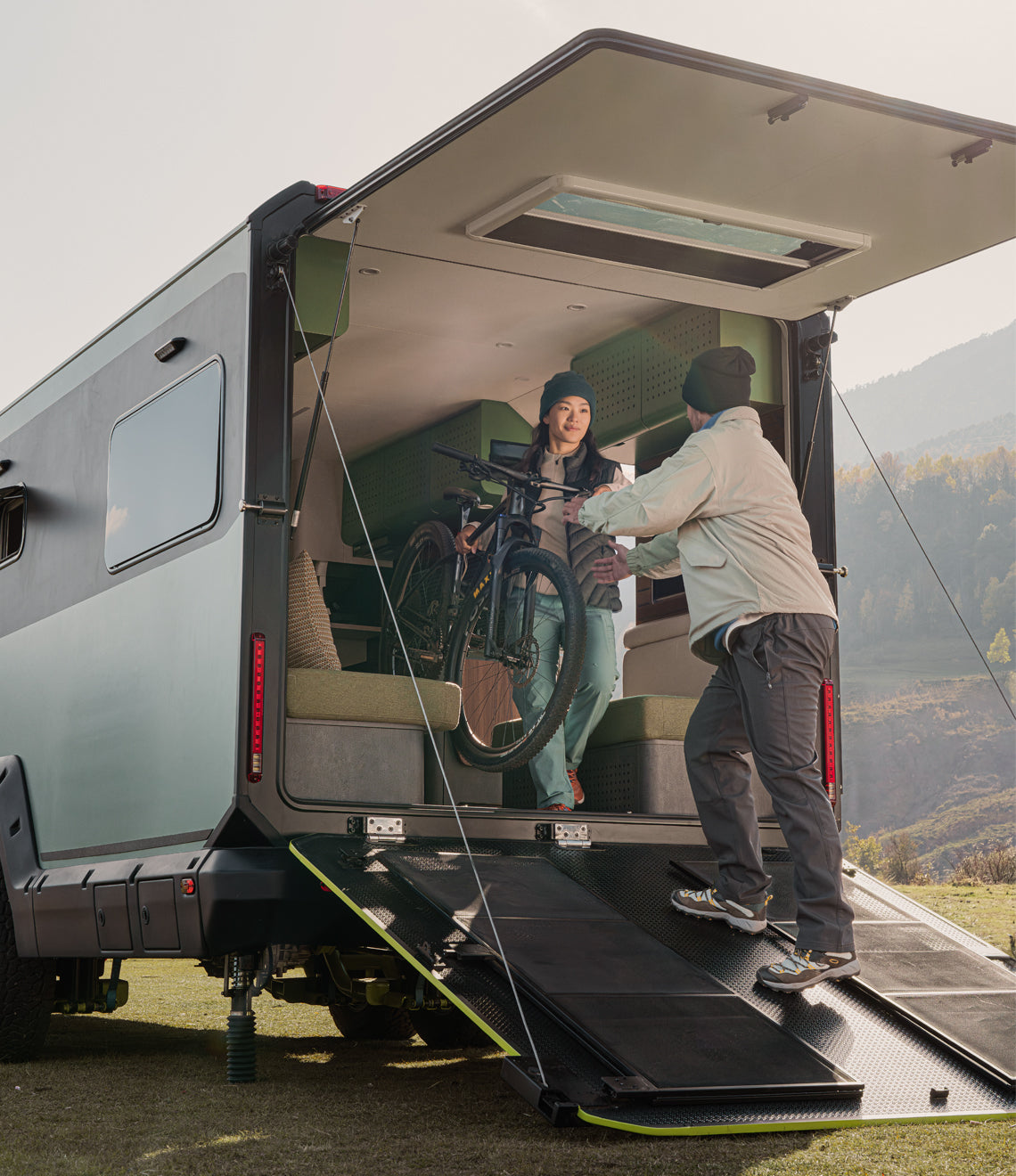
The Evotrex-PG5 is built to hold up out here. It is a travel trailer with onboard power generation, open for preorder now, that keeps its batteries charged without a hookup no matter how cold the night gets. With the Evotrex-PG5 you can hold a high basin or a Wind River bench comfortably, and the only thing you hear is the wind, not a generator.
Frequently asked questions
Is dispersed camping free in Wyoming? Yes. On most national forest and BLM land there is no fee and no permit for standard dispersed camping. You are trading services for that freedom, so there are no hookups, water, or trash service.
How long can you dispersed camp in Wyoming? It depends on the manager. BLM land allows 14 days within any 28 day period. The Bridger Teton allows 14 days in any 30 day period within a 5 mile radius, and near Jackson the limit drops to 5 days from May 1 through Labor Day.
Can you dispersed camp in Yellowstone or Grand Teton? No. Both national parks require a developed campground or a backcountry permit. Free dispersed camping happens on the surrounding forests and BLM land.
Do you need to store food? Yes, across most of western and northern Wyoming. This is grizzly country, and forests require all attractants to be secured so wildlife cannot reach them.
Can you have a campfire? Only when current restrictions allow it. Wyoming counties and field offices move in and out of fire restrictions through the summer, so check your exact area first and always carry a stove as a backup.
Check before you roll
- Look up the specific forest or field office rules for your exact site.
- Check the current fire restrictions and any active camping closures.
- Confirm the access road is open and passable for the size and weight of your rig.
- Plan your food storage; most of the state is bear country.
- Fill water, empty tanks, and plan your power before you leave pavement.
- Download offline maps; cell service is unreliable once you are off the highway.