
Dispersed Camping in Missouri: Where to Go and How to Do It Right
Missouri hides some of the most underrated free camping in the Midwest, spread across the wooded hills, clear rivers, and pine glades of the Ozarks. Dispersed camping means camping for free on public land outside a developed campground, with no hookups, no water, and no services. Unlike western states, Missouri has no Bureau of Land Management land, so nearly all of it happens on one place: the Mark Twain National Forest. This guide covers where it is allowed, the rules that keep you legal, the strongest areas to aim for, and how to come prepared so a night deep in the timber is comfortable rather than stressful.

Where dispersed camping is allowed in Missouri
The heart of free camping in the state is the Mark Twain National Forest, a patchwork of roughly one and a half million acres scattered across the southern half of Missouri and managed by the US Forest Service. Dispersed camping is allowed in most parts of the forest, and it is free with no permit required.
Beyond the national forest, options are narrower. Many Missouri Department of Conservation areas allow limited camping, but only where it is listed as an activity for that specific area, and some restrict you to designated sites rather than open ground. A handful of Army Corps of Engineers lakes also allow primitive camping in places. When in doubt, the national forest is the reliable home base, while conservation areas are a case by case bonus.
The rules every Missouri dispersed camper needs to know
A few rules apply across the Mark Twain National Forest, and knowing them keeps you out of trouble.
Stay limit. Camping is limited to 14 days within any 30 day period. Once you reach that limit, you have to break camp and move to a new location, and no further camping is allowed in the forest until the 30 day window closes.
Keep your distance. Set up at least 100 feet away from trails and from any water source such as a creek, spring, or lake. Use existing pullouts and clearings rather than carving out new ground, and never drive off road to reach a view.
Follow the motor vehicle map. Each ranger district publishes its own Motor Vehicle Use Map showing which roads are open and where you may pull off to camp. Download the map for your district before you go, because a road that is open in one area may be closed in the next.
Handle fire carefully. Where fires are allowed you may collect only dead and downed wood, never standing or living trees. Missouri fire danger and county burn bans change through the season, so look up current fire restrictions for your exact area before you plan a fire, and carry a stove as a backup.
Leave no trace. Dispersed sites have no toilets, no trash service, and no treated water. Bury human waste at least 6 inches deep, pack out everything you pack in, respect quiet hours from 10 at night until 6 in the morning, and leave the site cleaner than you found it.
Best areas for dispersed camping in Missouri
Eleven Point Ranger District (south central Missouri). Wild river country near the Eleven Point, with float in camps and quiet forest roads. This is classic Ozark scenery and a strong pick for paddlers who want to combine water and timber.
Salem Ranger District (central Ozarks). About 175,000 acres on the Salem Plateau, laced with forest roads and close to the Current River and the Ozark Trail. Primitive car camping with no facilities is the norm here.
Poplar Bluff Ranger District (southeast Missouri). Roughly 150,000 acres at the southeastern edge of the Ozarks, where the hills start giving way to lowlands. Good shoulder season camping when the higher country is cold.
Swan Creek area (near Ava). A non motorized zone of oak and pine with dispersed sites and clear water. A good choice when you want to camp away from traffic, with wood fires limited to dead and downed material.
| Area | Land manager | Best season | Hookups | Good to know |
|---|---|---|---|---|
| Eleven Point Ranger District | US Forest Service | Spring to fall | None | River and float in camping |
| Salem Ranger District | US Forest Service | Spring to fall | None | Near the Current River and Ozark Trail |
| Poplar Bluff Ranger District | US Forest Service | Fall to spring | None | Milder low country in cooler months |
| Swan Creek area | US Forest Service | Spring to fall | None | Non motorized, dead and downed wood only |
Power in the Ozark backcountry
Mark Twain dispersed camping tucks you into Ozark hollows and along spring fed streams, well off the grid and under a thick canopy. Water and waste are straightforward. The shade and the humidity are what make power the real planning problem, since solar rarely gets a clean, full day down in the hollows.
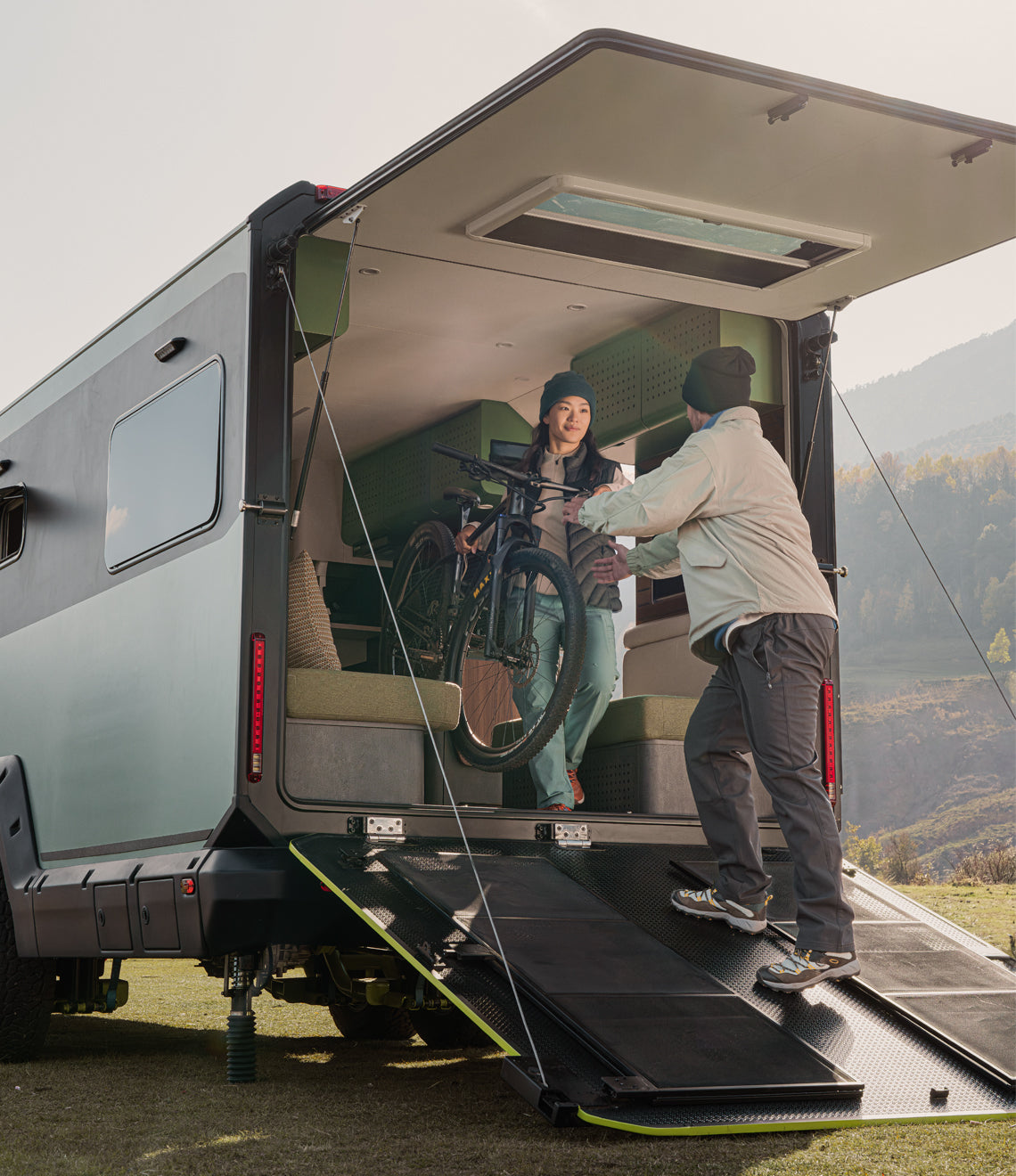
The Evotrex-PG5 is made for exactly this. This travel trailer generates its own power onboard and is open for preorder now, so it keeps charging whether or not the sun reaches your site. With the Evotrex-PG5 you can settle into a quiet hollow for days without a generator running or a battery bank you have to babysit.
Frequently asked questions
Is dispersed camping free in Missouri? Yes. On the Mark Twain National Forest there is no fee and no permit for standard dispersed camping. You are trading services for that freedom, so there are no hookups, water, or trash service.
How long can you dispersed camp in Missouri? Up to 14 days within any 30 day period on the national forest. After that you must break camp and move on, with no further camping in the forest until the window resets.
Do you need a permit? Not for standard dispersed camping on the national forest. Some Missouri Department of Conservation areas have their own rules and may restrict you to designated sites, so confirm each area before you go.
Can you have a campfire? Only when current fire restrictions allow it, and only with dead and downed wood. Missouri moves in and out of burn bans through the year, so check your exact area first and always have a stove as a backup.
Where can you dispersed camp in the Ozarks? The Mark Twain National Forest spans much of the Ozarks, with dispersed sites across the Eleven Point, Salem, and Poplar Bluff districts among others.
Check before you roll
- Look up the specific ranger district rules and Motor Vehicle Use Map for your exact site.
- Check current fire restrictions and any county burn bans.
- Confirm the access road is open and passable for the size and weight of your rig.
- Fill water, empty tanks, and plan your power before you leave pavement.
- Download offline maps; cell service is unreliable once you are off the highway.