
Dispersed Camping in Massachusetts: What Is Actually Allowed
If you are looking for the kind of dispersed camping you find out West, where you pull off a forest road and camp free on public land with no reservation, Massachusetts will disappoint you. The honest answer is that the state has essentially no true dispersed camping. There is no Bureau of Land Management land here and no national forest. Almost all camping happens in designated campgrounds run by the state, and pitching a tent wherever you like is not permitted. This guide explains the real rules, points you to the closest thing to primitive or remote camping the state offers, and shows how to camp legally and self contained when hookups are limited.

Where dispersed camping is allowed in Massachusetts
The short version: it is not. Nearly all public camping land in Massachusetts is managed by the Massachusetts DCR, the Department of Conservation and Recreation. State regulation 302 CMR 12.08 is blunt about it. No person may camp on DCR property except in a designated campsite, camping structure, or camping area. There is no legal version of driving down a fire road and picking your own spot for the night.
That means the free, permit free, park anywhere model does not exist in Massachusetts the way it does in states with vast federal land. What the state offers instead is a network of developed campgrounds inside its state forests and reservations, plus a small number of designated backcountry sites that come closer to a remote experience. Everything requires a reservation, and everything has an assigned site.
The rules every Massachusetts camper needs to know
A handful of DCR rules apply across the system, and knowing them saves you a wasted drive.
Designated sites only. You must camp in an assigned, designated site. Off road parking and camping to reach a quiet view is not allowed and damages the land.
Reservations are required. DCR camping is booked through ReserveAmerica, and walk in registration is not permitted. You can make a same day reservation online up until 2 p.m. on your arrival date, but you cannot simply show up and set up.
Stay limit. Between Memorial Day and Labor Day you cannot occupy a single facility for more than 14 consecutive days without department approval.
Backcountry limits are tighter. At designated backcountry campsites and shelters, no person or group may stay more than two consecutive nights except in an emergency. Groups using backcountry sites may not exceed ten people, and you must pack out all litter and waste.
Leave no trace. Primitive and backcountry sites have no trash service and often no potable water. Carry your own water, store food securely, and leave the site cleaner than you found it.
The closest thing to primitive or remote camping
Massachusetts will not give you open dispersed camping, but a few state forests in the Berkshires offer designated sites that feel genuinely remote. These are the options to aim for if solitude matters more than hookups.
Mount Greylock State Reservation. The Sperry Road campground is a primitive hike in experience on the state's highest peak, with wooded sites under a mature red spruce forest. It is a walk to reach, roughly a two mile trek up from a parking area or about 1.3 miles from a lot higher on the mountain. Group camping runs about $35 per night for Massachusetts residents and $100 for non residents.
October Mountain State Forest (Lee). At roughly 17,000 acres this is the largest state forest in the state, with the Appalachian Trail running through it. The campground has 44 sites and three yurts tucked under tall pines, each site with a fire pit and picnic table. Fees are about $17 for residents and $54 for non residents.
Savoy Mountain State Forest. A quiet former orchard in the northwestern Berkshires with 45 spacious sites, four log cabins, and two ponds for fishing and swimming. Note that camping here is scheduled to close July 31, 2026 for a bathhouse construction project, so confirm it has reopened before you plan a trip.
| State forest | Manager | What you get | Hookups | Good to know |
|---|---|---|---|---|
| Mount Greylock | Massachusetts DCR | Primitive hike in sites | None | Walk in from parking, no drive up |
| October Mountain | Massachusetts DCR | Wooded sites and yurts | None | Largest forest, on the Appalachian Trail |
| Savoy Mountain | Massachusetts DCR | Spacious sites and cabins | None | Camping closing July 31, 2026 for work |
Camping quiet and self contained
Even at a designated Massachusetts site you are usually camping without hookups, and the best sites, the remote and primitive ones, have the least of everything. That puts power squarely on you, and it puts a premium on doing it quietly, since a generator is exactly the thing that ruins the calm these sites are prized for.
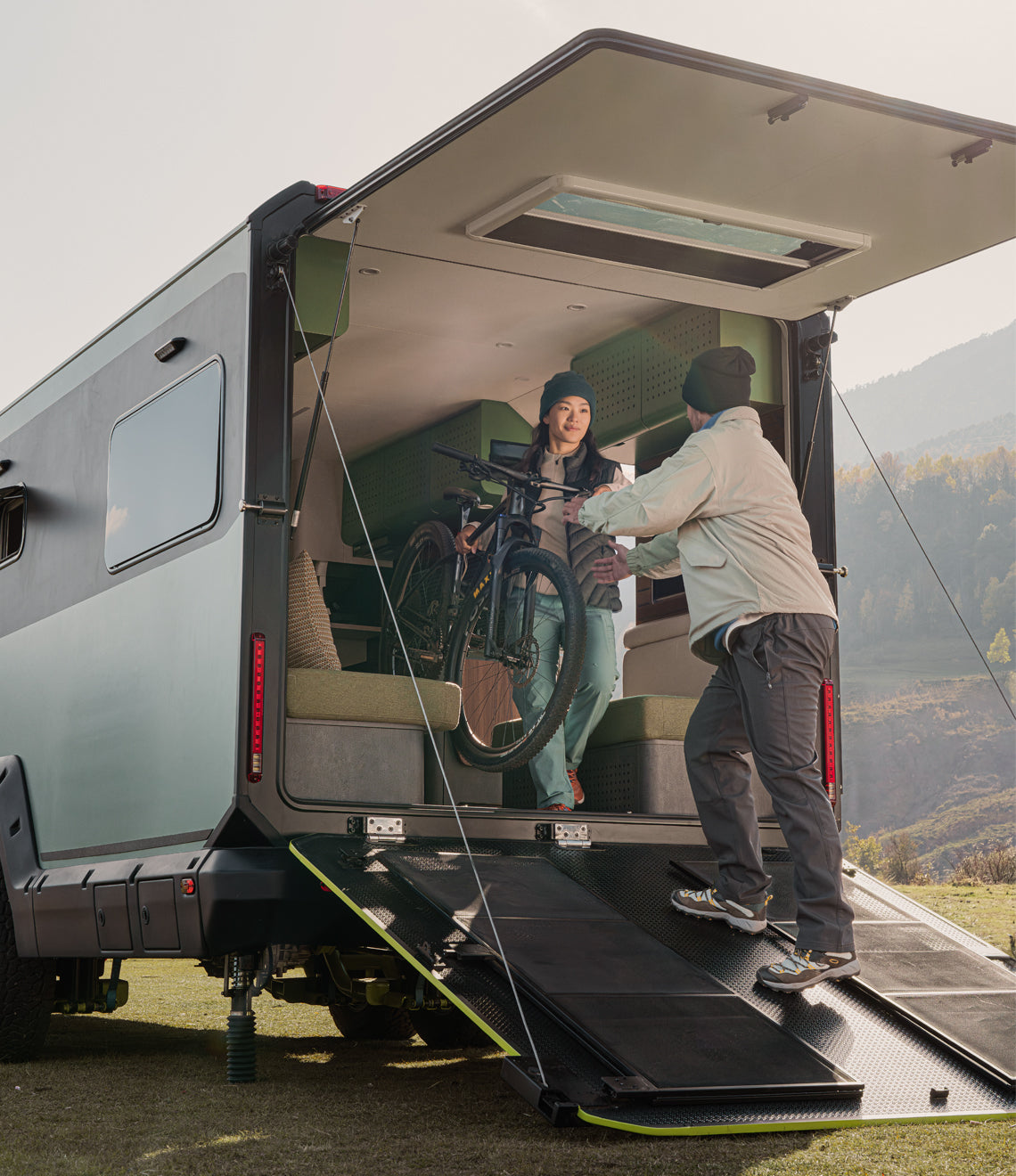
The Evotrex-PG5 answers both at once. It is a travel trailer that generates and stores its own power onboard, available to preorder now, so a site with no pedestal is not a problem. Because the Evotrex-PG5 makes its own electricity, you keep everything running through a still Berkshire evening without a generator breaking the quiet.
Frequently asked questions
Is dispersed camping legal in Massachusetts? Generally no. DCR rules allow camping only in a designated campsite, structure, or area, so free, pick your own spot dispersed camping is not permitted on state land.
Is there any free camping in Massachusetts? Not in the public land sense found out West. Almost all legal camping is in reserved, paid DCR sites. There is no BLM land or national forest here to camp on for free.
What is the closest thing to remote camping? Designated backcountry and primitive sites, such as the hike in Sperry Road sites at Mount Greylock, come closest. They still require a reservation and an assigned site.
Do I need a reservation? Yes. DCR camping is booked through ReserveAmerica, walk in registration is not allowed, and you can reserve the same day only until 2 p.m.
How long can I stay? Between Memorial Day and Labor Day the limit is 14 consecutive days at one facility. Backcountry sites are capped at two consecutive nights.
Check before you roll
- Confirm your exact site is reserved; walk in camping is not allowed.
- Check whether the site has any hookups or is primitive, and plan power and water accordingly.
- Verify seasonal closures, including the Savoy Mountain construction closure, before you drive.
- For hike in sites, confirm the distance from parking and pack for the walk.
- Download offline maps; cell service is unreliable in the Berkshires.